The laminated counter at your local motor vehicle branch carries a specific kind of low-frequency hum. Fluorescent tubes chatter overhead while a paper ticket curls between your knuckles, stamped with a letter and a three-digit sequence that never moves fast enough. You show up with a folder full of your domestic life: a stamped utility bill, an embossed birth certificate, and a bank statement pulled fresh from the printer to secure that tiny gold star in the upper corner of your plastic credential.
You answer the quick prompt on the electronic signature pad, smile for the lens beneath the harsh white flash, and pocket your paper receipt thinking you have squared your accounts with the state for the next four years. It feels like an ordinary bureaucratic chore completed on an extended lunch break, tidy and final.
Yet deep inside the server racks that bridge your department of motor vehicles and your municipal elections bureau, an invisible handoff takes place—and it rarely moves cleanly. While you walk out into the parking lot believing your paperwork is settled, an algorithmic database synchronization error is already quietly decoupling your voter record from the precinct rolls you have walked to every November for a decade.
The Ghost in the Conveyor Belt
Most citizens view registration as a fixed flag planted in their local soil, assuming that once their name enters the county ledger, it remains undisturbed until they intentionally file a relocation form. But modern government administrative software treats your residency less like an anchored landmark and more like a fluid digital stream. When you process a Real ID renewal, you are not merely ordering an identification card; you are triggering an automated cross-database reconciliation protocol designed to sweep across multiple state agencies at midnight.
The system relies on an automated matching logic that operates with ruthless, mechanical literalism. If your newly standardized Real ID application lists your address as “Suite 4B” while your municipal voter registration roll has held you at “Apt 4-B” since 2018, the batch ingestion routine registers a structural mismatch. Rather than asking a human clerk to reconcile the punctuation, state motor-voter clearinghouses routinely classify the discrepancy as an unverified address conflict. In an administrative effort to prevent duplicate files, the algorithm defaults to marking the existing municipal voter registration as inactive or pending, sending an automated verification postcard that frequently gets lost in the junk-mail pile.
- Municipal transit concessions eliminate discount commuter fares triggering furious rider boycotts
- Prevailing wage rules expire at midnight leaving county contractors facing sudden penalties
- OFAC transaction filters freeze routine small business payroll deposits without prior warning
- County school board redistricting splits historic voting precincts into diluted suburban quadrants
- County water conservation boards override elected commissioners to restrict residential lawn irrigation
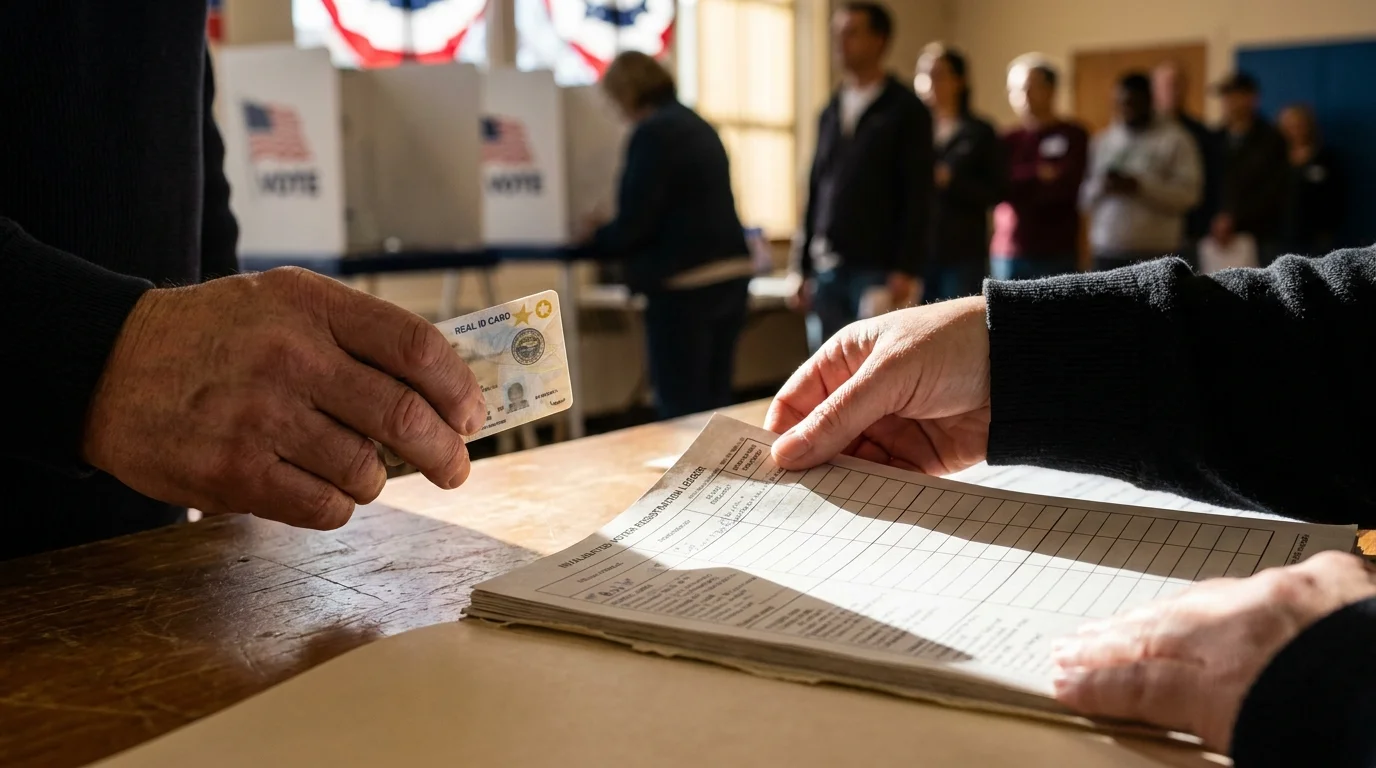
Consider Clara Vance, a 48-year-old high school biology teacher and precinct captain in suburban Denton County, Texas. Last spring, Clara renewed her credential to meet federal travel regulations, opting into the prompt that affirmed her address had stayed unchanged. Six months later, during a routine municipal school board special election, she discovered her name scrubbed from the active poll book, replaced by a grayed-out status flag requiring a provisional affidavit ballot. A misplaced directional abbreviation on the Real ID intake terminal—“North Main Street” truncated to “N Main” by an automatic character limit—had triggered an unnotified purge workflow in the county clerk’s automated database sweep.
Where the Friction Points Fracture
Not every renewal runs into an identical tripwire. The algorithmic pipeline fragments voters along specific demographic and spatial fault lines, turning tiny clerical nuances into unexpected poll-booth disqualifications.
The Recent Mover or Multi-Unit Tenant
If you live in an apartment complex, townhome subdivision, or multi-family flat, you sit directly in the software’s blind spot. Motor vehicle intake software frequently uses postal standardization software that truncates secondary unit designators. When your Real ID file strips the word “Unit” down to a bare number, the voter registration portal reads the record as an incomplete physical dwelling. You remain active on the state’s licensing ledger, but the municipal roll flags you as non-domiciled, pushing your ballot into the provisional holding bin before you even reach the check-in table.
The Dual-Surname or Hyphenated Commuter
Names that carry spaces, accents, hyphens, or generational suffixes like “Jr.” and “III” consistently jam automated clearinghouse scripts. If your driver credential prints with a condensed hyphen while your original town voter registration contains a space, the nightly API call fails the strict-identity match rule. Because the system cannot automatically certify that both entries belong to the exact same human, it quietly drops the voter registration record down to an administrative hold status, awaiting manual clerical intervention that understaffed county boards rarely resolve before election morning.
The Signature Capture Gap
Real ID requires a fresh digital capture via low-resolution stylus pads. These digitized strokes are instantly translated into compressed vector coordinates and mapped to your registration profile. If your stylus stroke fails to calibrate closely with the pen-and-ink voter signature your town clerk keeps on file from years ago, municipal signature-verification scanners flag the disparity during ballot-petition or vote-by-mail processing. You don’t get a phone call; you get a canceled ballot.
Mindful Steps to Shield Your Ballot
Protecting your franchise does not require an advanced degree in administrative law, but it does require setting aside fifteen intentional minutes to manually inspect what automated state software quietly scrambled behind your back.
- Pull your raw record directly from the source: Never rely on third-party aggregators or general election tracking apps. Navigate directly to your local county registrar or municipal board of elections portal and look up your active registration status.
- Perform a character-for-character audit: Compare the precise physical spelling, unit designations, and directional prefixes on your newly minted Real ID card against the screen readout of your voter profile. If your card says “St” and your voter profile says “Street,” contact your town clerk to align them manually.
- Audit your registration thirty days out: Automated batch processing schedules generally dump motor-voter address updates into municipal queues at the close of every business month. Check your standing four weeks prior to any ballot deadline to catch system changes while the statutory correction window is wide open.
- Request written proof of restoration: If an administrative hold or address query is uncovered, do not simply click “update” and close your browser. Phone the municipal registrar, request a confirmation receipt number, and ask for a stamped certificate of registration mailed directly to your physical address.
The Bigger Picture
We often think of administrative disenfranchisement as an act of deliberate malice, a dramatic political brawl fought out in public view. The quieter reality is that civil rights are far more frequently eroded by unmaintained software routines, incompatible server architectures, and character limits programmed into twenty-year-old state mainframes. When you demand absolute alignment across your public files, you are doing more than securing a piece of paper—you are actively denying the system permission to erase your voice through bureaucratic neglect.
“The machinery of local governance fails not when people choose not to speak, but when silent algorithmic errors discard their records before they even step up to the podium.”
| Key Point | Detail | Added Value for the Reader |
|---|---|---|
| Data Truncation | DMV software frequently cuts off unit numbers and directional street tags during batch transfers. | Helps you pinpoint the exact typographic mismatch that triggers algorithmic address holds. |
| Signature Compression | Stylus pad signatures recorded at license renewals often fail optical matching against old ink files. | Prevents your vote-by-mail ballot from being rejected by automated verification scanners. |
| Inter-Agency Lag | Motor vehicle files can take up to eight weeks to clear county clerk intake queues. | Provides a clear defensive timeline so you never miss your state’s voter correction cutoff. |
Frequently Asked Questions
Does opting into voter registration during my Real ID renewal guarantee my status is active?
No. While the motor vehicle clerk passes your information along, municipal election authorities must independently process and verify the batch data. If an algorithmic field mismatch occurs between databases, your registration can be held in pending status without your knowledge.Why did my voter status change if I have lived at the same residence for decades?
Even if your address has not changed, the Real ID standardization protocol forces your existing information through federal postal matching algorithms. This process can alter how your street name, abbreviations, or apartment designations are recorded, which often flags your old municipal file as conflicting or obsolete.What is the quickest way to confirm my ballot status before heading to the polls?
Check your registration status directly on your county board of elections or municipal registrar’s official portal rather than relying on statewide licensing sites. Ensure that your name, address, and residency match character-for-character with your identification.What should I do if a poll worker claims my registration was dropped after my license renewal?
Do not leave the polling place. Request an emergency verification from the precinct supervisor by having them telephone the head county registrar immediately to locate your archive file. If your name cannot be found, exercise your federal right to cast a provisional ballot and demand written instructions for the statutory cure process.How long before an election should I complete my Real ID renewal to avoid processing delays?
It is best to complete any credential renewal at least sixty to ninety days before early voting begins. This buffer allows sufficient time for the automated state clearinghouse to transmit your updated file and gives you enough room to manually resolve any accidental administrative flags.