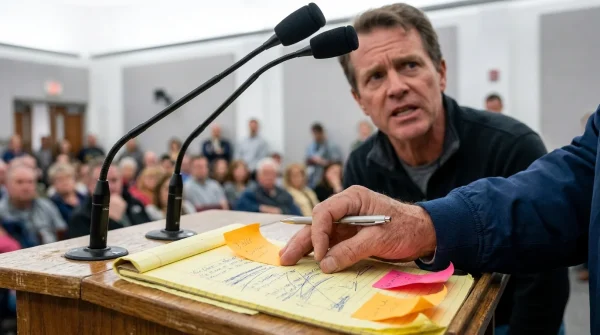
The hum of fluorescent tubes in the municipal basement auditorium starts to drill into your temples around 8:15 on a Tuesday evening. A styrofoam cup leaks lukewarm coffee onto your jeans as you lean forward in a molded plastic chair. Across the dais, your elected councilmember thumbs through a three-hundred-page agenda packet, squinting under the harsh glare. Outside, evening traffic thins along the bypass, and everyone in the gallery still believes that democracy runs on basic arithmetic: hands go up, the gavel falls, and the town retains control over its own skyline.
Then the municipal attorney approaches the microphone with the relaxed posture of someone who already knows the final score. He does not debate the traffic studies or the strained sewer lines. Instead, he speaks in a flat, quiet murmur about statutory regional compacts, state-level housing density targets, and administrative preemption. Your council members sit entirely paralyzed, their legal authority stripped by an unelected regional planning commission that met twenty-five miles away on a Thursday morning without a single resident from your zip code in the gallery.
The realization hits like breathing through an icy wool blanket. You did not lose a political argument on the merits of neighborhood scale or road safety. You walked into an elaborate theater where the script had been finalized three fiscal quarters prior by an intergovernmental board whose members will never stand for election, answer your emails, or drive the roads they just voted to overwhelm.
The Phantom Circuit: Understanding the Administrative Bypass
Local government is often understood as a neat, tiered hierarchy: you elect city councilors, they hire city staff, and together they draft municipal zoning. When a developer wants to erect a four-story apartment block over a quiet cul-de-sac of mid-century ranches, conventional wisdom insists they must persuade that council to grant a variance. If the council says no, the project dies on the floor.
That conventional wisdom is an antique relic. Regional planning commissions operate as a phantom electrical circuit installed behind the drywall of local government. When a developer hits a wall with an elected city council, they do not mount a public relations campaign; they simply flick the switch on an intergovernmental advisory panel established under obscure regional development acts. These panels hold statutory authority to approve housing density allocations that override city master plans.
By reframing massive high-density projects as regional compliance matters, developers bypass municipal code entirely. The elected board becomes merely ornamental, reduced to rubber-stamping state-mandated growth corridors under threat of crippling municipal litigation from regional authorities.
- Municipal pension payroll withholdings silently slash take-home wages across public sector stubs
- Hormuz shipping route blockades trigger sudden retail gasoline spikes across industrial corridors
- Church Committee transcripts expose unredacted intelligence directives targeting domestic antiwar leaders
- Andy Beshear public statements expose sharp media divide over Southern political power
- Fairfax County zoning disputes trigger furious suburban voter revolts against school boundary boards
Expert Context: The View from the Planning Desk
Marcus Vance, a fifty-two-year-old municipal land-use attorney who spent fourteen years drafting regional interlocal agreements before stepping back to advise independent townships, watched this structural coup unfold in real time. “Most citizens believe zoning battles are won at the municipal podium with heartfelt speeches about parking and tree canopies,” Vance explains, rubbing a thumb over the worn edge of a regional transit map. “In reality, the moment a town council accepts regional infrastructure dollars or joins a regional planning council to secure road paving funds, they quietly surrender home rule. The developer doesn’t lobby your mayor; they hire a planning consultant who sits on the regional commission’s technical advisory subcommittee. By the time the bulldozers roll in, your council has an administrative gun to its head.”
Mapping the Pressure Points: Where Municipal Authority Breaks
The machinery of unelected regional planning works through three distinct administrative levers, each designed to neuter local voter pushback while insulating bureaucrats from direct accountability.
The Infrastructure Subsidy Trap: Small and mid-sized cities constantly struggle to pay for wastewater treatment upgrades and arterial road repaving. To secure state and federal block grants, your elected council signs interlocal agreements that delegate regional growth forecasting to a multi-county council of governments. Hidden in the fine print of those regional compacts is an agreement to adopt minimum high-density residential quotas per square mile. If the city later refuses a mega-development, the commission threatens to pull future infrastructure funding, effectively starving the town’s public works department.
The Quasi-Judicial Veil: When regional planning commissions meet, they do not deliberate like legislators; they operate under quasi-judicial rules. This means public comment is sharply restricted to technical evidence rather than community preference. If an engineer hired by the developer presents computer models claiming regional runoff standards are met, the commission legally must approve the project, ignoring any emotional plea or historic preservation concern raised by residents who have lived along the creek bed for forty years.
The Builder’s Remedy Inversion: When regional commissions update their five-year housing element plans, they deliberately establish residential growth projections that traditional suburban zoning cannot mathematically satisfy. The moment your city’s zoning code falls out of strict compliance with these regional forecasts, developers gain the statutory power to force projects through under judicial preemption doctrines. Your local master plan is legally declared invalid overnight.
Intercepting the Machine: A Citizen’s Procedural Playbook
Rallying twenty neighbors with hand-painted yard signs at a council meeting makes for good local television, but it does nothing to stop an administrative override. You must attack the transmission line where regional authority plugs into municipal law.
- Audit the Interlocal Agreements: Search your city clerk’s records for the foundational Joint Powers Agreement or Council of Governments charter. Identify the exact clause detailing voting weight and opt-out windows.
- Challenge the Technical Advisory Committee: These subcommittees draft the density quotas before the regional board ever votes. Find their meeting notices—often buried on county subdomains—and submit written evidentiary counter-testimony on traffic trip-generation metrics.
- Force a Municipal Sovereign Vote: Compel your elected council to vote on a formal resolution asserting municipal land-use supremacy, forcing the regional commission to file a public declaratory judgment action rather than executing a quiet administrative bypass.
Focus your attention on the administrative record. If you can inject documented engineering flaws, sovereign treaty boundaries, or environmental exemptions into the regional commission’s docket before their formal hearing closes, you strip them of their judicial immunity, forcing their legal counsel to pump the brakes.
Tactical Toolkit: Procedural Counters
- The 60-Day FOIA Drill: Request all email correspondence between the developer’s land-use planner and the regional commission’s staff planner dating back twelve months. You will almost always find pre-application coordination that contradicts public notices.
- The Capacity Demand Notice: Demand your town’s fire district conduct an independent aerial ladder apparatus access audit for the proposed parcel footprint, independent of the regional transit agency’s density calculations.
- The Resolution of Withdrawal: Draft and circulate a citizen-sponsored ordinance requiring the city to withdraw from the regional planning council upon ninety days’ written notice, stripping the unelected board of its local jurisdiction.
Reclaiming the Ground Under Your Feet
There is a profound, grounding relief in shedding the illusion of conventional civic participation. When you stop treating the town council hearing as a forum for persuasion and begin seeing it as an administrative chess game, the board loses its mystique. The unelected officials who reshape your street rely on silence, procedural exhaustion, and the public’s naive trust in ballot-box remedies.
Understanding that local control has been quietly routed through an unmonitored regulatory backchannel is not cause for despair. It is the tactical map you have been missing. Once you learn where the real leverage is hidden, you can step into the planning office not as a helpless petitioner, but as a citizen who knows precisely which wire to cut.
“True local sovereignty does not vanish at the ballot box; it is surrendered inside the procedural bylaws of multi-county advisory pacts.”
| Mechanism | Administrative Function | Added Value for the Reader |
|---|---|---|
| Interlocal Compacts | Binds municipal infrastructure grants to mandatory high-density housing targets. | Reveals why elected officials claim they have no legal authority to vote against massive projects. |
| Quasi-Judicial Standing | Restricts public testimony strictly to technical, civil-engineering evidence. | Shows you why emotional appeals fail and how to focus your efforts entirely on technical flaws. |
| Preemption Injunctions | Allows regional bodies to bring lawsuits that invalidate local single-family zoning laws. | Provides the legal vulnerability needed to draft local municipal withdrawal ordinances. |
Frequently Asked Questions
Can a city council simply vote to ignore a regional planning commission?
No, not without facing immediate lawsuits. Once a city joins a regional compact, state law generally treats regional development allocations as mandatory baseline standards. To regain control, a municipality must legally amend or withdraw from the underlying interlocal agreement.Who actually appoints the members of these regional planning boards?
They are typically a mixture of county commissioners, appointed city managers, and unelected representatives from regional utility or transit authorities. This design insulates them from direct voter removal.Why do elected local officials agree to these partnerships in the first place?
Money and liability. State and federal transportation and clean water grants are increasingly bundled together, requiring cities to belong to an approved regional planning entity before funds are distributed.Does submitting a citizen petition stop a regional override?
Petitions carry zero legal weight in quasi-judicial planning proceedings. Regulators are required by law to evaluate only sworn testimony, certified engineering data, and local environmental standards.What is the single most effective action an individual resident can take?
Demand that your city council place an item on the public agenda to review and audit the city’s master agreement with the regional planning commission, targeting the specific clauses that waive municipal land-use vetoes.