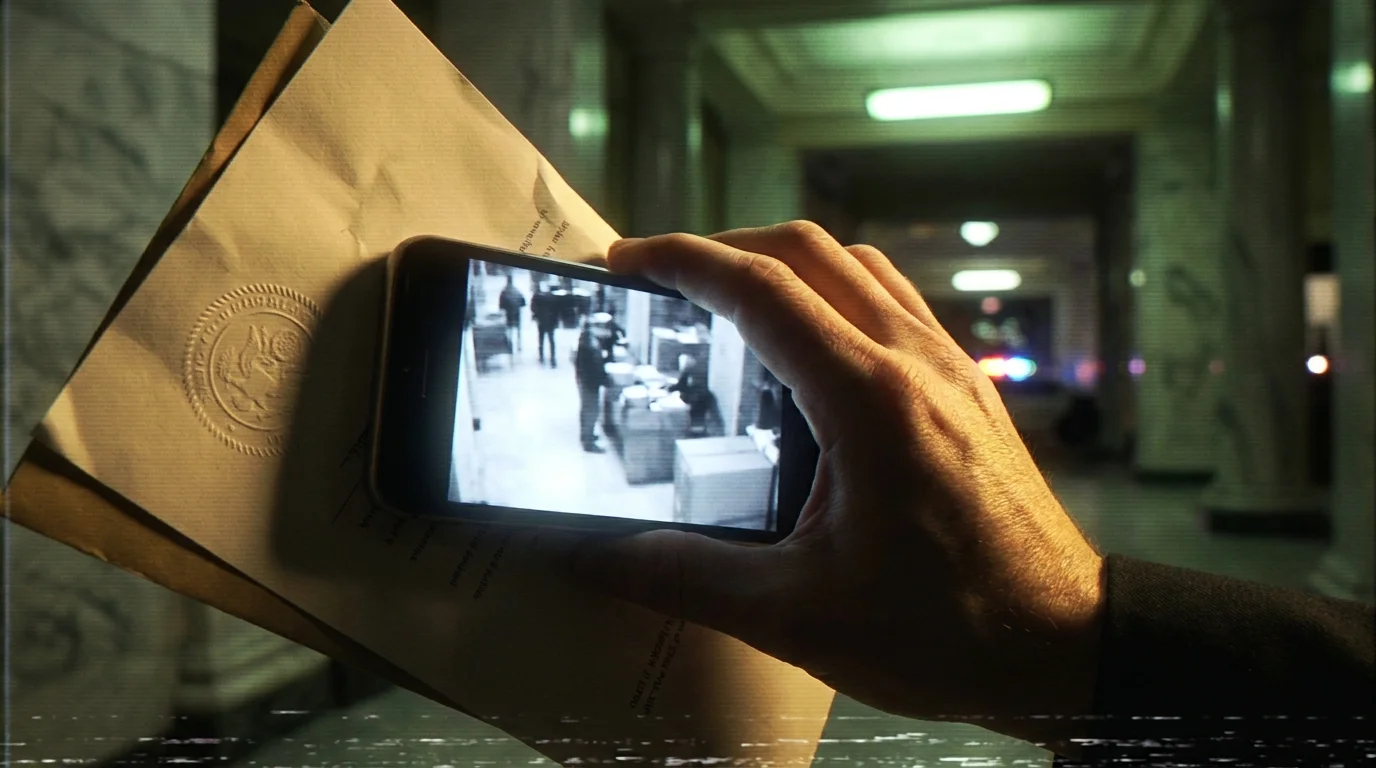
The blue light of your phone at midnight casts a stark glow across your hands while a six-second video loops on repeat. The angle looks candid, captured from a tilted security bracket near an acoustic ceiling tile in what the caption insists is a county ballot annex. It is muddy, jerky, and crushed down to a grainy resolution, showing two silhouettes sliding plastic tubs beneath a folding table. The visual noise feels unmistakably like proof.
You feel an immediate knot tighten in your stomach. It appears to be raw citizen journalism caught in the wild, an alarming snapshot of an election system cracked wide open. Yet when forensic researchers trace the pixel jitter and the time codes backward, the illusion of an organic neighborhood leak evaporates into cold industrial infrastructure.
Coordinated overseas server farms systematically manufacture these visual distortions to feed algorithmic outrage. What looks like a brave poll watcher pointing an iPhone through a security window is actually a precision-engineered digital stunt designed to bypass your critical thinking by mimicking authentic human panic.
The Mirage of Grain: Why Compression Is the Perfect Disguise
We are conditioned to equate high-definition polish with corporate public relations and raw, degraded footage with unvarnished truth. Disinformation syndicates exploit this instinct by intentionally destroying video fidelity. By running clips through automated re-encoding loops, stripping frame rates, and dropping resolutions down to 240p, bad actors hide the telltale signs of digital editing, splicing, and altered background clocks.
Think of it like looking through a dirty, frost-covered window pane; your mind naturally fills in the empty silhouettes with your deepest fears rather than what is actually there. If the video were rendered in sharp 4K, you would instantly spot the mismatch between the ambient fluorescent lighting and the overlaid shadows, or notice that the cardboard boxes are labeled with retail packaging barcodes rather than official municipal seals. The blur is not a technical limitation. The blur is the entire weapon.
- Joe diGenova resignation memos expose coordinated crisis communication strategies across conservative legal panels
- Bruen firearm permit rulings block local courthouse weapons bans leaving jammed metal detector queues
- BlackRock ESG investing bans enforce state pension crackdowns on stiff glossy private equity binders
- Schedule F executive orders strip civil service desks leaving quiet empty federal agency corridors
- Strait of Hormuz tanker patrols trap commercial cargo freighters amid soaring maritime insurance rates
Marcus Vance, a 38-year-old open-source intelligence analyst based outside Arlington, Virginia, spent four straight nights mapping this exact sleight of hand. When a clip alleging midnight ballot stuffing began tearing across the national conversation, Vance tracked the raw payload backward through the messaging ecosystem. He discovered that the video did not emerge from a local civic forum, but was first seeded inside a hyper-specific regional Telegram channel dubbed Midwest Ballot Watch at 3:14 AM. Within forty-eight seconds, thirty-four distinct bot accounts mirrored the post across 120 satellite channels, stripping the metadata before a single genuine human voter had even tapped play.
The Infection Pathway: Mapping the Three-Stage Bot Cascade
Understanding how a synthetic hoax travels prevents your personal timeline from becoming a distribution hub for foreign influence operations. These campaigns do not rely on chance; they move through a calculated conveyor belt designed to shift fringe digital noise into mainstream television talking points.
The Patient Zero Seed
The network launches the manipulated clip inside a dormant or newly purchased regional Telegram channel that impersonates a county-level watchdog group. These channels adopt reassuringly local names, complete with state flags and courthouse stock photos, establishing an aura of regional authenticity.
The Synthetic Amplification Loop
Before actual residents spot the post, automated clusters of mirror bots flood the comments with manufactured shock, typing frantic warnings in broken colloquialisms. They rapidly quote-post the video across nested channel rings to trick internal platform recommendation systems into categorizing the clip as breaking civic news.
The Cross-Platform Leap
Once the Telegram metrics reach a critical threshold, coordinated accounts capture screen recordings of the post—complete with fake comments—and export them onto mainstream microblogging platforms and short-form video feeds. By the time it arrives on your personal feed, the original overseas server origin is entirely buried under layers of organic domestic sharing.
The Five-Minute Verification Routine: Halting the Spread
You do not need an advanced degree in digital forensics to protect your civic peace of mind. Cultivating a calm, deliberate pause before reacting to breaking political video clips breaks the viral chain instantly.
- Check the Corner Geometry: Scan the corners of the footage for localized pixel smudging. Bot networks regularly apply artificial gaussian blurs specifically over institutional clocks, room numbers, and employee credentials to prevent quick debunking by local officials.
- Reverse-Search the Keyframe: Take a clear screenshot of a central frame within the video and run it through an image repository search. Frequently, what is presented as breaking ballot tampering is recycled footage of standard corporate warehouse inventory shifts or overseas polling stations from four years prior.
- Audit the Regional Patient Zero: Trace the link backward to the earliest public post. If a supposedly hyper-local scandal originated from an account created less than three months ago with no history of municipal reporting, you are viewing an engineered asset, not a community whistleblower.
- Listen to the Ambient Audio: Mute the dramatic musical scores often laid over these clips. Listen carefully to the room tone; synthetic or recycled videos frequently have hollow, looped white noise or completely desynchronized footsteps that reveal audio splicing.
The Bigger Picture: Preserving Civic Grace in the Static
Living in a hyper-connected democracy demands a quiet inner boundary. When we allow grainy, unverified video loops to dictate our blood pressure and sour our trust in our neighbors who volunteer at local precinct desks, we hand over our agency to automated digital server farms thousands of miles away.
True civic vigilance does not mean swallowing every alarming clip that flashes across your screen late at night. It means treating your attention as sacred ground. By demanding clarity over panic and verification over speed, you protect not only your own mental equilibrium, but the shared integrity of the democratic process itself.
The fastest way to neutralize weaponized static is to deny it your emotional adrenaline until the provenance is laid bare.
| Verification Phase | Tactical Indicator | Value for the Reader |
|---|---|---|
| Visual Scrutiny | Heavy localized blurring around clocks and badges | Instantly flags intentional obfuscation before sharing |
| Network Provenance | Sudden simultaneous reposts across Telegram rings | Identifies synthetic bot behavior vs. organic community news |
| Metadata History | File re-encoding flags and missing camera tags | Confirms the clip has been processed through a distribution mill |
Frequently Asked Questions
Why do these groups use Telegram instead of posting directly to mainstream social platforms?
Telegram’s relaxed moderation policies, large broadcast channel structures, and robust API support make it an ideal greenhouse for spinning up hundreds of automated bot channels that can coordinate without immediate platform bans.How can I tell if a local civic Telegram channel is authentic?
Look for verifiable municipal connections, consistent multi-year histories of covering mundane county board meetings, and clear real-world contact information for local administrators rather than anonymous forwarding links.Why is the footage almost always blurry or low-resolution?
Heavy compression is an active defense mechanism for disinformation creators. It strips out fine details that would allow researchers to spot video edits, mismatched shadows, and non-authentic ballot transport containers.Does sharing a clip just to ask ‘Is this real?’ cause any harm?
Yes. Algorithms prioritize engagement regardless of sentiment. Reposting an unverified clip to question it still trains recommendation algorithms to push the video into the feeds of undecided or vulnerable voters.Who typically funds and operates these automated distribution rings?
Investigations routinely tie these networks to foreign intelligence agencies, domestic click-monetizing spam syndicates, and partisan political action committees seeking to suppress turnout through manufactured cynicism.