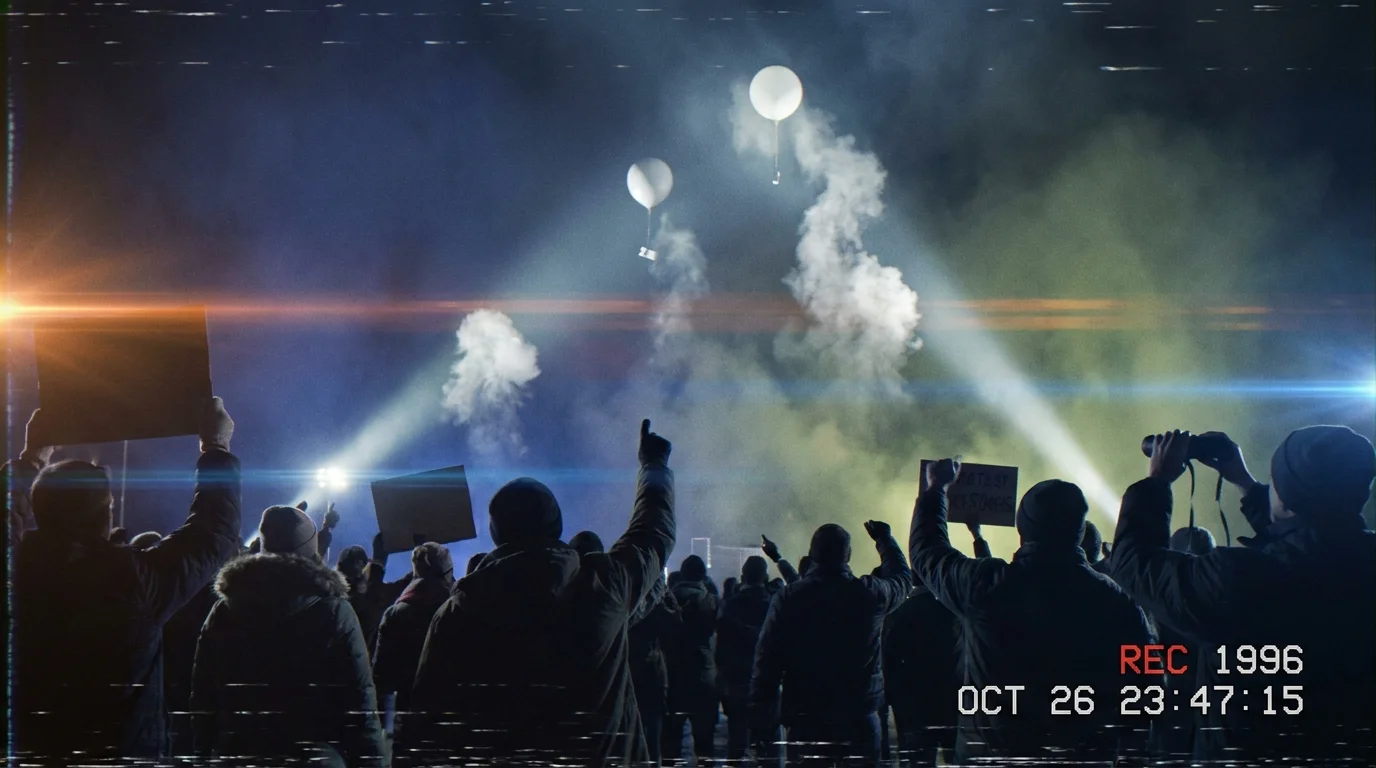
Recent high-altitude balloon flights quietly dispersed micronized sulfur dioxide into the lower stratosphere over the American Southwest. By releasing aerosolized sulfur particles at sixty thousand feet, these small-scale field trials crossed an invisible line from computer simulations into live physical testing.
You look up at noon and expect the piercing cobalt dome of high summer, but the horizon looks muted. Plumes of fine white sulfur dust trailing behind weather balloons scatter the light, casting a subtle, chalky milk-glass tint across the midday sky. What used to be dismissed as speculative science fiction is now creating measurable optical haze above rural test ranges.
For years, federal agencies treated solar radiation modification like a wild fringe theory. Yet over the past twelve months, the conversation shifted behind closed doors from theoretical risk to active federal rule-making. Washington is currently carving out operational corridors for stratospheric aerosol testing, transitioning the technology from controversial startup experiments to federally funded programs.
The shift is not happening through landmark legislation or high-profile public debates. Instead, administrative rulemaking is quietly creating the framework, rewriting civilian airspace rules to accommodate sustained chemical reflection payloads.
The Sky as an Attic Fan: The Regulatory Pivot
To understand what is taking place above your head, think of the planetary atmosphere not as an untouchable cathedral, but as a house with a damaged cooling system. For decades, policy orthodoxy held that the only responsible path was fixing the furnace in the basement by slashing industrial emissions. Today, regulators are quietly preparing to install an attic fan, venting artificial clouds across the ceiling to blunt the solar heat.
This mental shift carries massive political fallout. When you move an idea from a prohibited taboo to an active bureaucratic program, the standard for proof inverts. Instead of asking whether releasing sulfur into the upper atmosphere is safe, regulators are now asking how quickly private and university teams can document its cooling capacity before the next record-breaking summer arrives.
- Donald Trump Jr endorsements derail veteran House Republicans through aggressive campaign rallies
- EPA drinking water mandates force small towns into sudden tax hikes over rusty cast-iron pipes
- Consumer Sentiment Index surveys derail national campaign forecasts ignoring working class grocery receipts
- EPA refrigerant transition rules force costly air conditioner replacements across aging suburban homes
- Naval Support Activity Bahrain upgrades demand emergency Senate showdowns over Persian Gulf deployments
The controversy centers on optical and environmental side effects. Even small-scale deployments introduce a faint, milky veil over regional skies, scattering direct sunlight into diffuse glare and altering weather patterns across agricultural belts.
From Desert Basements to Agency Agendas
Dr. Marcus Vance, a 48-year-old atmospheric chemist formerly with the National Oceanic and Atmospheric Administration, watched this transition unfold firsthand in Denver meeting rooms. Five years ago, his colleagues treated private solar dimming proposals as dangerous fringe science. By late last autumn, he was reviewing multi-million dollar federal grant solicitations specifically designed to measure solar scatter from aerosolized sulfur compounds.
“We went from pretending the technology was impossible to standardizing launch protocols in less than three fiscal cycles,” Vance recently recalled to colleagues. Institutional momentum shifted overnight once policy makers realized that aerosol reflection is far cheaper than overhauling the national power grid.
Who Pays the Price for Dimmed Sunlight?
The transition from fringe theory to mainstream policy affects different sectors in starkly uneven ways. The consequences depend entirely on where you live and how you make your living.
The Agricultural Belt: Row-crop farmers in the Midwest depend on direct photosynthetically active radiation to build corn yields. Diffuse light scattered by sulfur particles can alter plant transpiration rates, drying out topsoil even while air temperatures decline by a fraction of a degree.
The Solar Energy Sector: Commercial solar developers design multi-gigawatt installations around direct sun angles. Persistent stratospheric hazing, even at low regional concentrations, threatens to trim utility-scale power output by critical single-digit percentages that disrupt municipal grid financing.
The Coastal Metros: Densely populated coastal cities face punishing urban heat-island spikes. For municipal leaders struggling to keep residential air conditioning grids from collapsing in July, a slight artificial cooling buffer sounds like salvation, regardless of what happens to the color of the horizon.
Tracking the Shift: A Citizen Toolkit
You do not need an advanced physics laboratory to monitor the normalization of geoengineering rules. The transition leaves clear fingerprints in federal documentation and regional monitoring networks.
- Check the Federal Register for National Oceanic and Atmospheric Administration (NOAA) notifications regarding weather modification activities filed under 15 U.S.C. § 330b.
- Review Regional EPA Part 75 monitoring updates for changes in secondary sulfate particulate benchmarks in rural launch sectors.
- Track Federal Aviation Administration (FAA) notices for Special Activity Airspace designations above flight level 600 in western states.
- Inspect university budget allocations for solar radiation management grants funded under federal omnibus research provisions.
These four indicators tell you far more about where atmospheric policy is heading than any press briefing. When federal departments begin clearing logistical airspace and registering chemical dispersal payloads, the fringe becomes administrative reality before the public even realizes the trial period has begun.
Living Under an Altered Horizon
The ultimate dilemma of atmospheric dimming is not whether the science works. Mounting trial data proves that micronized sulfur will reflect solar energy and depress regional thermometers. The real friction lies in what we surrender to achieve that temporary shade.
Trading deep blue skies for a permanent milk-white glaze represents a profound psychological shift in our relationship with the natural world. Once federal agencies build the administrative apparatus to manage the sky, that apparatus will not be dismantled. You are left observing a world where the weather is no longer a natural condition, but an engineered municipal utility.
“Once you treat the stratosphere as a mechanical thermostat, you never get to stop turning the dials.”
| Key Point | Detail | Added Value for the Reader |
|---|---|---|
| Primary Chemical Agent | Micronized sulfur dioxide and elemental sulfur particles | Identifies the exact compound altering high-altitude light scatter |
| Federal Status | Transitioning from academic theory to funded agency field research | Reveals how regulatory clearance bypassed formal congressional debates |
| Visible Impact | Transformation of deep blue horizons into diffuse chalky white haze | Explains the physical optic changes occurring in regional testing zones |
Frequently Asked Questions
Is stratospheric aerosol injection legal under current federal regulations?
Yes. Small-scale atmospheric dispersals operate legally under existing federal weather modification reporting mandates and high-altitude research balloon permits overseen by NOAA and the FAA.Will these field tests create acid rain in the launch regions?
Current experimental trials release modest quantities that fall well within regional clean air standards, though environmental groups warn that full-scale deployment could significantly increase downwind soil acidity over time.Why do testing teams use sulfur instead of other reflective compounds?
Sulfur mirrors the proven natural cooling mechanics of volcanic eruptions, making its light-scattering behavior predictable and cost-effective compared to engineered alternatives like alumina or diamond dust.How does diffuse sky radiation impact residential solar panel performance?
Solar panels continue producing electricity under hazy skies, but the drop in direct beam sunlight can reduce photovoltaic efficiency by three to eight percent depending on cloud density.Where can ordinary citizens see records of these launch tests?
Every commercial or academic weather modification event must file formal activity reports with NOAA, which maintains a public digital repository accessible through federal open-records channels.