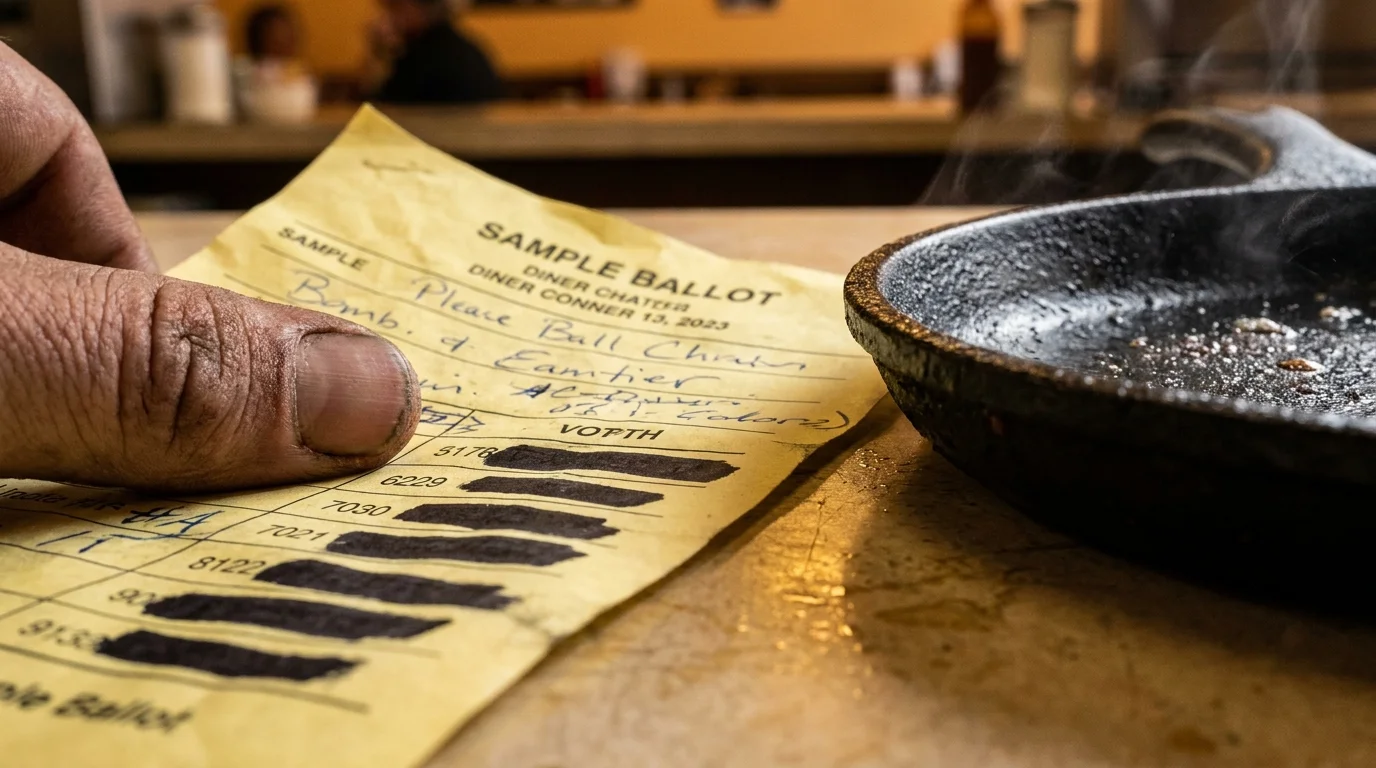
The grease on the flat-top griddle snaps against seasoned steel, filling the narrow diner aisle with the heavy aroma of smoked ham hocks and buttered grits. Morning light filters through blinds coated in decades of river-town humidity, cutting across vinyl booths where stacks of greasy napkins sit pinned beneath heavy white ceramic mugs. You can hear the dull scrape of spatulas, the murmur of farm reports from a low-mounted television, and the steady rustle of crinkled yellow sample ballot slips being smoothed out across formica tables.
Campaign buses idling on the shoulder of Route 52 kick up road dust, carrying consultants convinced their seven-figure programmatic ad buys have softened the electorate. They run the numbers through synthetic models and target suburban zip codes with calibrated streaming spots, assuming that digital repetition manufactures genuine voter intent. Algorithms cannot share a table when the Sunday sermon lets out, and they certainly cannot look a county elder in the eye to answer for forgotten promises.
When the early exit tallies filter out of these lowcountry and Pee Dee outposts, national pundits consistently express surprise at the sudden evaporation of media-driven frontrunners. They misinterpret the silence of rural precincts for indecision, completely blind to the fact that the real vetting was concluded three weeks earlier between the griddle and the register.
The Taproot Network vs. The Digital Cloudburst
To understand the South Carolina primary, you have to discard the modern assumption that political momentum travels through digital screens. Think of a high-dollar advertising blitz as an August thunderstorm over hard-packed red clay: it makes an enormous amount of noise and washes the topsoil into the road ditch, but very little moisture sinks down to where seeds actually germinate. A primary gauntlet is not won in the atmosphere; it is decided in the root system.
For generations, outside campaigns have landed in Columbia or Charleston with binders full of cross-platform attribution models, only to watch their numbers collapse in the second tier of rural precincts. Real power moves through kin, church rosters, and civic fraternal lodges where institutional memory stretches back fifty years. You can buy five thousand television spots across the Florence and Augusta broadcast markets, but if the deacon who runs the local youth sports league does not recognize your field director at the diner counter, your campaign does not exist.
Consider Martha Gable, a 71-year-old retired magistrate and precinct captain in Marion County. On the third Thursday of every primary cycle, Gable sets herself up in the corner booth of a highway pantry diner with an indexed three-ring binder and three ballpoint pens. Over black coffee and fried salt pork, over three dozen extended cousins, municipal workers, and church ushers sit down across from her to cross-examine the crinkled yellow slips she prints on her home machine. A half-hour conference at Martha’s table regularly flips four entire voting wards faster and more permanently than three weeks of satellite television saturation.
- Defense Production Act mandates spark quiet factory retooling orders bypassing gridlocked congressional votes
- Farm Bill negotiations switch billions in crop subsidies inside windowless basement markup suites
- Chris Christie debate stage pivots derail rehearsed talking points using sudden forward shoulder feints
- Pete Buttigieg town hall pauses trap hostile network interviewers through calculated deadpan vocal drops
- James Talarico viral sermon clips force state party leaders into aggressive public school funding defenses
The Three Layers of Precinct Gatekeeping
If you want to read the real anatomy of early state momentum before television networks call the callout races, you have to isolate the specific layers where voter trust is actually negotiated:
The Fellowship Hall Endorsement: Long before a candidate steps behind a podium, regional faith leaders evaluate whether an operative understands local pain points. These discussions happen over potluck casseroles, where loyalty is treated as a physical commitment rather than an ideological abstraction.
The Courthouse Breakfast Circuit: County supervisors and probate judges hold court at the county seat diner every weekday morning at daybreak. Their casual nods of approval signal to local volunteers whether a visiting delegation deserves door-knocking muscle or polite neglect.
The Multi-Generational Family Ledger: In rural voting clusters, entire blocks of ballots follow the quiet recommendation of a family patriarch or matriarch who tracks decades of local appointments, road paving promises, and school board decisions.
How Ground Networks Dismantle Ad Buys
Surviving the southern firewall requires shifting your focus from broadcast volume to relational density. When field operations prioritize personal proximity over top-down media, precinct dynamics tilt immediately.
Watching this dynamic play out requires observing four quiet, disciplined steps:
- Bypassing regional media buyers to establish direct physical contact with ward leaders at least six months ahead of the filing deadline.
- Equipping grassroots captains with physical, tactile sample ballots that voters can hold, fold, and carry into the voting booth without confusion.
- Attending non-political civic rituals—volunteer fire department fish fries, youth baseball openers, church anniversaries—without speaking from a microphone.
- Replacing canned national talking points with specific, granular commitments regarding local infrastructure, medical clinic staffing, and county tax relief.
The Tactical Toolkit:
- Field deployment ratio: 1 paid staffer per 3 multi-generational precinct networks (rather than 1 per 10,000 targeted digital impressions).
- Sample ballot timing: Distribute printed collateral within a tight 48-hour window before early voting begins to prevent opposition counter-messaging.
- Voter contact window: Schedule home-visit touches exclusively between 4:30 PM and 6:15 PM, matching rural factory and transit shift returns.
The Quiet Sovereignty of the Physical Precinct
In an era dominated by hyper-reactive internet cycles, the quiet diner booth remains a stubborn, stabilizing sanctuary of American civic life. It forces candidates to sit shoulder-to-shoulder with people whose lives cannot be altered by a viral video or an algorithmic engagement spike.
When you recognize that a crinkled slip of paper held by a trusted neighbor carries more sovereign authority than a ten-million-dollar Super PAC media buy, your understanding of politics shifts completely. Physical presence remains the currency that never depreciates, reminding us that democracy, at its core, is still an exercise in shaking someone’s hand and meaning it.
The voter who trusts their grandmother’s precinct recommendation will look right past ten million dollars of television attack ads without blinking once.
| Key Point | Detail | Added Value for the Reader |
|---|---|---|
| Relational Infrastructure | Multi-generational family clusters and local church networks act as natural ballot gatekeepers. | Explains why internet hype routinely fails to translate into physical delegate victories. |
| Physical Sample Ballots | Hand-to-hand distribution of simple paper guides immediately before precinct opening. | Shows the decisive utility of low-tech, high-trust materials inside early voting booths. |
| Diner-Counter Vetting | Direct, unscripted engagement between campaign emissaries and civic community anchors. | Reveals where true political viability is established long before statewide polls close. |
Frequently Asked Questions
Why do national polls consistently misread South Carolina primary results?
National surveys rely heavily on automated calling and digital panel samples that consistently miss rural voters whose political participation is mediated entirely through local church networks and civic lodges rather than online platforms.What makes the yellow sample ballot slip so influential?
These slips represent trusted endorsements from familiar precinct leaders. For voters navigating lengthy multi-candidate fields, having a physical guide handed to them by a respected family elder provides immediate clarity and trust.Can a massive digital campaign ever override local precinct leaders?
Historically, digital ad spend fails to dislodge entrenched community endorsements in early southern primaries. Voters in these regions place supreme value on physical presence and sustained institutional accountability over slick media production.Why are rural diners central to campaign operations?
Rural diners serve as the de facto town halls for municipal decision-makers, school board members, and informal precinct captains, offering a concentrated environment where authentic community consensus is brokered daily.How early must a campaign establish diner and church contacts to win?
Successful campaigns typically plant dedicated field organizers within local counties at least nine to twelve months prior to the primary to earn genuine standing within community gatekeeping circles.