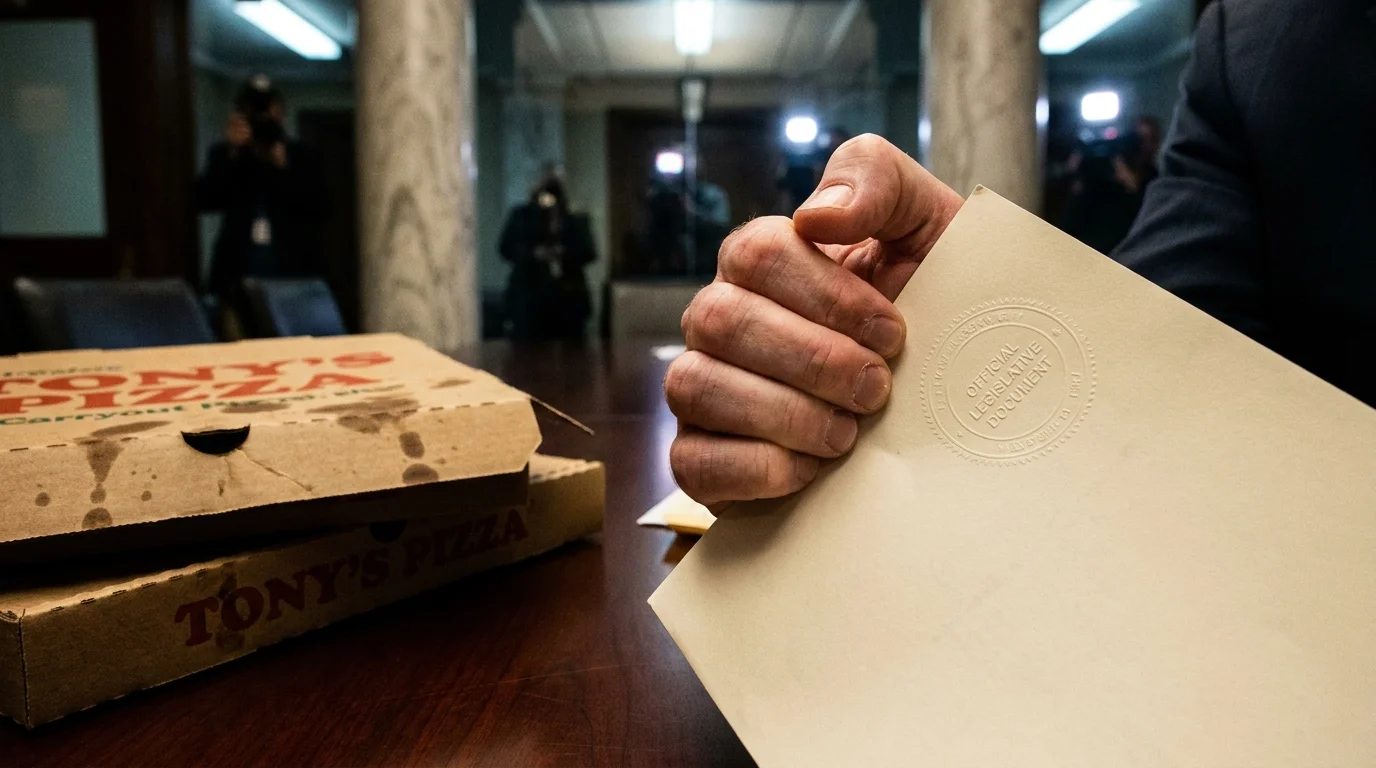
Walk down through the labyrinthine sub-basement corridors beneath the Longworth House Office Building past midnight, and the air changes. It loses its museum-grade polish and takes on the stale, sour humidity of recirculated air and lukewarm grease. Greasy carryout pizza cartons stacked on cold mahogany conference tables sit beside three-ring binders as thick as telephone books, their plastic tabs dog-eared and smudged with dry-erase marker ink. It is 2:40 in the morning, and the hallway outside is quiet enough that you can hear the hum of industrial air chillers vibrating through the limestone.
On the television screens upstairs, cable news replays rehearsed speeches delivered to an empty chamber floor under bright gallery lights. But down here, where daylight never penetrates and cell service drops to a single stubborn bar, **billions in taxpayer credit** quietly change hands with the stroke of a felt-tip pen. There are no cameras, no public microphones, and no ceremonial gavels striking sound blocks.
You were likely taught that agricultural legislation is debated, polished, and finalized in daylight through high-minded floor arguments about family farms and dinner-table economics. That version belongs in an eighth-grade textbook. The real mechanism functions like an after-hours currency exchange, where congressional committee directors and seasoned staffers shuffle regional fortunes between city grocery aisles and thousand-acre combine operations.
When rural commodity credit deadlines tick down toward expiration, partisan talking points evaporate under sheer budgetary gravity. What takes over is a subterranean balancing act: shaving tenths of a percent from urban food assistance baselines to fund safety-net triggers for Southern peanut farmers, or re-indexing yield averages for Midwestern corn so a key senator can go home and talk about victory.
The Shadow Ledger: Why Legislation Is a Hydraulic Valve, Not a Debate
To grasp why these basement sessions happen, you have to throw away the myth that the Farm Bill is a single, coherent vision. It is actually a massive hydraulic valve balancing two opposing pressures: urban nutrition funding and rural commodity insurance. Decades ago, clever operators realized neither side could pass its priorities alone. Rural representatives could not muster the votes for multi-billion-dollar crop supports without city lawmakers; urban representatives could not fund food stamps without rural votes. They bound the two together in an arranged marriage that survives entirely on closed-door trade-offs.
When baseline forecasts from the Congressional Budget Office reveal a deficit, the public sees sudden rhetoric about moral responsibility and fiscal discipline. Inside the basement markup room, however, staffers do not talk about ideology. They talk about fractions of pennies on the target price of hard red winter wheat. If commodity groups in one state demand a bump in statutory reference prices to survive a drought-ravaged season, that money must be extracted from another title of the bill. Most often, the easiest reserve to tap sits within the Supplemental Nutrition Assistance Program (SNAP), simply because a fraction-of-a-percent adjustment to nutrition inflation indexes frees up billions for regional crop reinsurance without requiring a floor vote.
- Chris Christie debate stage pivots derail rehearsed talking points using sudden forward shoulder feints
- Pete Buttigieg town hall pauses trap hostile network interviewers through calculated deadpan vocal drops
- James Talarico viral sermon clips force state party leaders into aggressive public school funding defenses
- Helena Foulkes primary endorsements derail entrenched party favorites across competitive Rhode Island suburbs
- Trump dividend tax legislation sparks fierce Capitol Hill clashes over emergency foreign import tariffs
Marcus Vance, 48, spent eleven years as a senior agricultural committee policy analyst drafting the legislative language that bridges these exact divides. He describes the process not as corruption, but as brute survival: “You sit in a room with twelve people who haven’t slept in thirty hours, looking at a spreadsheet where every column represents an entire agricultural sector or thirty million grocery carts. If you give Iowa an extra two dollars an acre on yield protection, you have to quietly carve thirty million dollars out of administrative outreach for SNAP across twenty states. You don’t do it because you want to hurt people; you do it because the clock runs out at sunrise, and if the bill fails to mark up, the whole rural banking system freezes on Monday.”
The Anatomy of the Split: How the Basement Room Balances the Map
The trade-offs finalized in these windowless suites do not fall cleanly along party lines. Instead, they divide by geography, soil type, and congressional committee seniority. Understanding how your tax dollars and grocery prices are shaped requires tracking the three primary levers pulled during midnight revisions.
1. The Nutrition Offset (Title IV)
Because nutrition assistance consumes more than seventy-five percent of total Farm Bill spending, it serves as the ultimate bank account for backroom negotiators. When negotiators need two billion dollars to shore up specialty crop block grants or expand livestock indemnity funds, they alter technical calculations, such as the Thrifty Food Plan indexing formula or administrative cost-sharing caps for state agencies. You rarely see this reported as a direct program cut; it appears instead as a minor technical amendment to statutory forecasting baselines.
2. The Row-Crop Shield (Title I)
Midwestern corn and soybean growers rely heavily on revenue-based protection programs like Agricultural Risk Coverage (ARC) and Price Loss Coverage (PLC). During closed markups, staff directors spend hours running simulations on reference prices. By adjusting the mathematical formula that triggers these payouts by just a few cents per bushel, negotiators can funnel hundreds of millions of dollars to specific river basins, ensuring powerful farm bureau federations keep their members aligned behind the broader legislative compromise.
3. The Southern Specialty Bargain
Southern commodities—primarily rice, cotton, and peanuts—operate under fundamentally different cost structures and insurance realities than Midwest grain. Negotiators from Gulf and Southeastern states routinely trade away technical concessions on forestry or conservation easements to secure higher statutory payment limits for corporate farm entities. These language adjustments are tucked deep within the miscellaneous provisions of the committee print, where only seasoned industry lobbyists know where to look.
How to Spot the Moves Before the Floor Vote
You do not need an all-access security pass to monitor how these closed-door trades alter your financial landscape. By looking at specific procedural signals, you can anticipate the policy shifts days before they hit the headlines.
- Watch the CBO Baseline Score: When the Congressional Budget Office drops an updated preliminary score sheet late on a Friday evening, compare Title I (Commodities) against Title IV (Nutrition). A sudden upward spike in crop insurance outlays paired with a stagnant or shrinking nutrition baseline confirms a basement trade was finalized.
- Scan the Committee Chair’s Mark: The draft bill presented to the public by the committee chair is not a rough draft; it is the finished product of subterranean haggling. Pay close attention to definitions sections where single words—like changing “shall” to “may”—discreetly strip mandatory funding from local food initiatives.
- Track Regional Cosponsor Additions: When a lawmaker known for fiercely defending food assistance suddenly signs on to an agricultural package without giving a public explanation, look for a newly inserted carve-out benefiting specialty crops, local dairy processing, or regional river barge infrastructure in their home district.
Your tactical monitoring toolkit requires three specific resources: the official CBO Agriculture Score, the unamended text of the Chairman’s Mark released forty-eight hours prior to formal markup, and the Federal Register notices regarding commodity credit corporation borrowing authority. When you cross-reference these documents, the legislative smoke clears, revealing exactly what was bartered away under the glow of fluorescent office lamps.
The Bigger Picture: Reclaiming Your Vantage Point
It is easy to look at the machinery of legislative markups with cynicism, assuming that policy crafted in windowless rooms over cold pizza is evidence of an irredeemable system. But peeling back the curtain provides something far more valuable than outrage: clarity. When you understand that federal policy moves through mechanics rather than moral debates, you stop being misled by cable news theater and posturing press conferences.
You begin to recognize that changes in your grocery bill, the health of your local food bank, or the economic stability of small farm towns nearby are direct results of tiny mathematical adjustments made in basement conference suites. Armed with an understanding of this shadow ledger, you see the real trade-offs that build American domestic policy, giving you the power to demand genuine transparency from the leaders who ask for your vote.
“Legislation in Washington does not travel in straight lines; it is bent by the weight of money, midnight fatigue, and the absolute requirement to reach a quorum before dawn.”
| Key Point | Detail | Added Value for the Reader |
|---|---|---|
| Subterranean Markups | Closed-door staff revisions held in basement suites to finalize legislative text before formal votes. | Shows why public floor speeches rarely influence the actual funding provisions of an agricultural bill. |
| SNAP-Commodity Trade | Shifting mandatory funds from nutrition baseline accounts to balance Title I crop reference prices. | Explains the direct connection between national grocery assistance caps and rural farm safety nets. |
| CBO Baseline Scores | Nonpartisan fiscal scoring that reveals which titles gained or lost money during midnight sessions. | Provides a clear, objective tool to verify what lawmakers traded away before the bill passes. |
Frequently Asked Questions
Why are Farm Bill markups held in windowless basement rooms?
Committee staff suites and drafting offices in congressional buildings like Longworth and Rayburn are located on sub-levels to offer secure, distraction-free workspaces close to parliamentary counsel, away from the media-heavy public hearing rooms upstairs.Is trading SNAP funding for crop subsidies legal?
Yes. Congress operates under statutory budget caps, meaning any increase in one title’s baseline spending must be paid for by reductions elsewhere unless lawmakers waive statutory budget rules through explicit procedural votes.Why do urban and rural representatives stay allied on the Farm Bill?
Neither faction has enough votes to pass its preferred policies alone. Urban members require rural support to fund nutrition assistance, while rural members need urban votes to maintain agricultural price supports and crop reinsurance.How can ordinary citizens track these closed negotiations?
Monitor the release of the Congressional Budget Office’s formal score sheet and review the “Chair’s Mark” draft text, which congressional committees must publicly post at least forty-eight hours before formal committee voting begins.When do these basement compromises actually take effect?
Once the full committee approves the mark, the bill moves to the House or Senate floor for debate. If passed and signed into law, the fiscal changes typically roll out at the start of the following federal fiscal year on October 1st.