The damp chill creeps straight through your wool socks the moment you step off the slush-slicked parking lot and onto the varnished floor of a local middle school gymnasium. The air smells faintly of floor wax, damp down parkas, and stale drip coffee poured from oversized commercial urns. Overhead, high-bay fluorescent tubes buzz at a low, relentless sixty hertz, casting an unvarnished glare across folding tables and wooden folding chairs.
You find an open spot on a drafty gymnasium bleacher, pulling your collar tight against the stray drafts rolling off the fire exit doors. From a distance, cable news networks paint presidential primaries as smooth wars of national broadcast spending, crisp teleprompter deliveries, and hundred-million-dollar super PAC buys. Up here, wedged between a retired high school wrestling coach and a local hardware store owner, that polished illusion evaporates entirely.
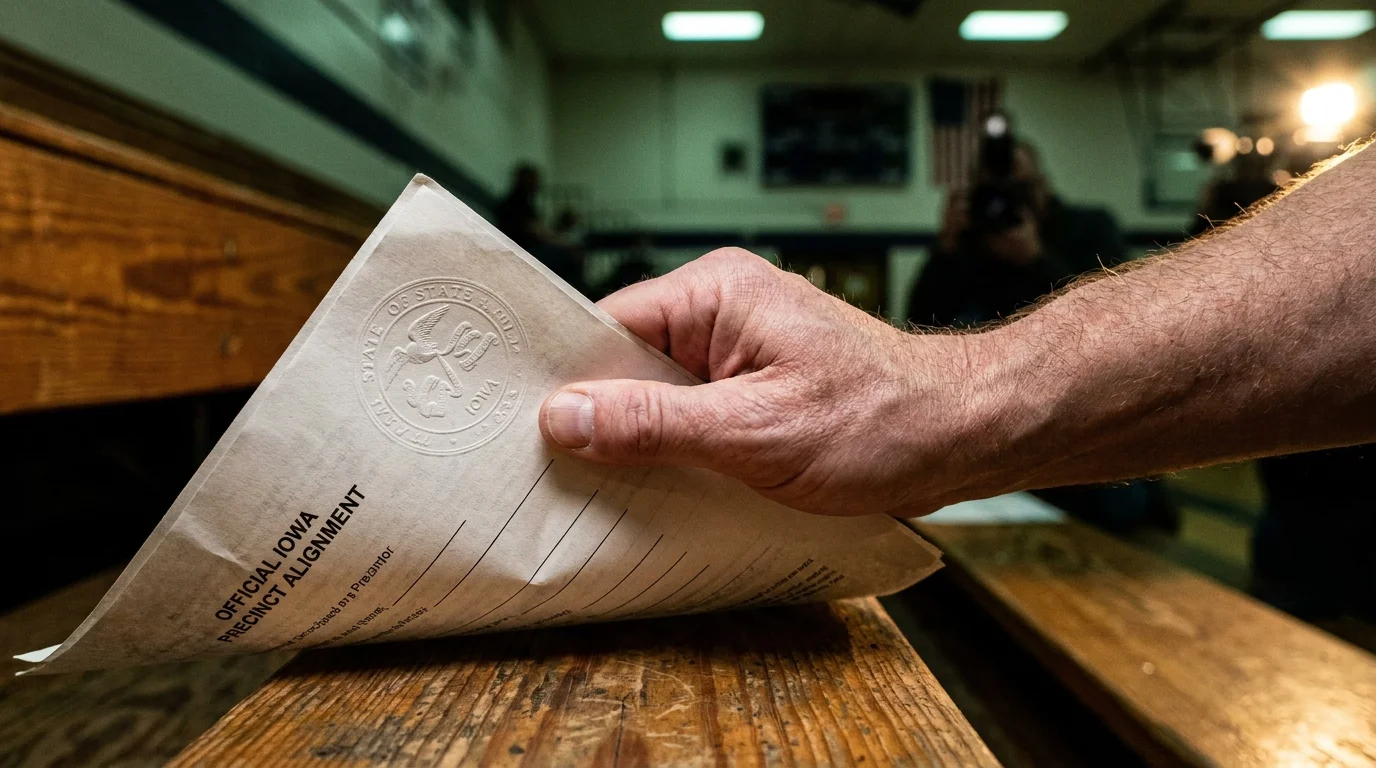
National campaign managers spend months obsessing over state-level aggregate polling, yet everything hinges on the quiet friction of eighty-six neighbors gathered in a single room on a sub-zero Monday evening. What decides the race is not an algorithm running on an ad server in Arlington, but the damp, stiff carbon of official Iowa caucus precinct sheets resting beneath the thumb of a volunteer precinct secretary.
The Illusion of the Airwaves: Arithmetic on a Varnished Floor
For months, the political ecosystem tries to persuade you that modern elections are won inside high-definition broadcast slots and digital micro-targeting funnels. You watch frontrunners blanket every evening newscast with thirty-second spot ads, assuming momentum is a tidal wave manufactured by sheer cash volume. But when the doors lock at seven o’clock sharp, broadcast dominance meets its physical wall: the rigid, unforgiving geometry of local precinct math.
A caucus is not a private ballot dropped into an electronic scanner before you drive to work; it is an open-air market of physical presence. The candidate who spent fifteen million dollars on local broadcast television in December discovers that television sets cannot stand in a designated corner of a gym. If their supporters stay home because the gravel roads are drifted with four inches of blowing snow, those ad dollars yield precisely zero bodies in the room.
The central paradox of this process is that raw popular enthusiasm means nothing without geographic concentration and operational discipline. If your candidate commands a passionate following scattered across three different towns, but fails to reach the mandatory mathematical threshold in this specific gymnasium, that entire block of national momentum is erased within forty-five minutes. The precinct sheet records only survivors.
- Federal Register desk copies strip agency authority with crisp black ink stamps
- Debate microphone kill switches force candidate stumbles under blinding studio spotlights
- Presidential inaugural address cadences trap undecided swing voters using rhythmic three-beat repetition structures
- Donald Trump forces party platform rewrites reversing traditional overseas defense spending priorities
- John Fetterman breaks party lines demanding swift domestic steel pipeline protections across manufacturing hubs
The Fifteen Percent Line: Inside Poweshiek County
Donald Miller, a fifty-eight-year-old grain elevator operator who has managed caucus night operations in Poweshiek County for three cycles, understands this mechanical cruelty better than any visiting cable news pundit. Standing beside the scorer’s table with a yellow legal pad and three clipped ballpoint pens, Donald does not care about national endorsements or digital fundraising records. His world operates on simple division: total attendees divided by delegates to be awarded, establishing a viability cutoff that commonly lands at fifteen percent.
He watches as seventy-two neighbors finish checking in at the folding tables, meaning any contender who cannot muster eleven physical bodies into their designated gym corner will be declared mathematically dead on the spot. In Donald’s room, a high-profile coastal senator with widespread national media fame had attracted exactly seven supporters, while a quiet, retail-focused governor had quietly packed twenty-two people into the bleachers. Donald simply pulled out his red grease pencil, crossed out the senator’s line on the preliminary worksheet, and announced to the drafty room that those seven voters had twenty minutes to find a new political home or go home.
Anatomy of the Floor: The Three Sorting Realities
To understand how frontrunners stumble, you have to break the floor down into its three mechanical phases. Each stage operates under entirely different psychological and operational pressures.
1. The Initial Sort (The Visual Census)
Voters walk across the floor to cluster under handwritten signs taped to folding chairs. Within ten minutes, every neighbor can see who has real ground support and who is merely a ghost of paid media. If your group is visibly sparse, your supporters begin to feel exposed, their confidence eroding under the gaze of friends and coworkers.
2. The Realignment Scramble (The Survival Auction)
When Donald blows the whistle to announce non-viable groups, the room instantly fractures into aggressive, retail negotiation. This is where pre-trained precinct captains earn their keep. They do not hand out bumper stickers; they offer community influence, school board compromises, and personal appeals to steer stranded voters into viable groups before the window shuts.
3. The Delegate Math (The Sheet Finalization)
Once the final clusters lock into place, the caucus secretary translates human heads into state delegate equivalents using fractional arithmetic. A candidate who barely clears the viability bar might take home the exact same delegate count as an opponent who spent three times as much money to secure just three more people. The official precinct sheets are signed, photographed on flip phones, and sealed in envelopes, permanently cementing the evening’s winners and casualties.
Decoding the Floor: A Tactical Survival Map
Navigating the reality of an early primary caucus requires throwing away traditional voter turnout playbooks. It demands an obsession with physical density over broad awareness.
Campaigns that survive the gymnasium floor follow a ruthless, non-negotiable sequence that prioritizes mechanical ground presence over rhetorical polish:
- Appoint an anchor for every twenty voters: The anchor never leaves their group, acting as a physical gravitational pull to prevent wavering neighbors from drifting toward exit doors during the chaotic realignment window.
- Drill precinct captains on viability formulas: Every captain must know the exact number needed to clear the threshold before the opening gavel falls, eliminating mid-meeting panic when room attendance fluctuates.
- Map secondary preferences in advance: Successful field organizers never assume their voters will stand firm if non-viable; they negotiate secondary alignment pacts with complementary campaigns weeks before caucus night.
- Guard the reporting paperwork: Ensure two verified observers stand directly beside the precinct secretary while raw headcounts are transcribed onto the carbon transfer sheets to prevent recording transcription errors.
The Tactical Toolkit for precinct operations relies on strict constraints: a mandatory 15% viability threshold across four-to-six delegate precincts, an unyielding 30-minute realignment clock, and two carbon-backed reporting sheets that must balance perfectly against the entrance registration binder before anyone leaves the building.
The Humbling Weight of the Direct Handshake
When the room empties and the custodian begins sweeping up the stray precinct flyers and discarded cardboard buttons, the silence returns to the gym. The fluorescent tubes turn off with a heavy thunk, leaving only the sound of freezing wind whistling through the seams of the emergency doors.
There is an undeniable dignity in this cumbersome, analog ritual. It cuts through the sterile, detached manipulation of national political marketing and forces candidates to face human beings who will ask them unscripted questions about local water runoff, farm credit access, and rural clinic closures. When an over-hyped national campaign collapses on these floorboards, it is not because the voters were confused by television ads. It is because seventy of their neighbors stood in a tight circle, looked at one another across the center court stripe, and decided that authentic presence matters far more than manufactured scale.
The loudest campaign spending in Washington means nothing until a precinct secretary writes down the headcount on cold carbon paper.
| Key Point | Detail | Added Value for the Reader |
|---|---|---|
| Viability Cutoff | Typically 15% of total verified attendees in a multi-delegate precinct. | Reveals why candidate preference numbers mean zero if support is spread too thin across town. |
| Realignment Window | A strict thirty-minute period where non-viable voters must pick a viable group. | Explains how secondary choices and local ground persuasion dramatically flip outcome margins. |
| Precinct Sheet Tally | The manual, signed physical form that assigns state delegate equivalents. | Demonstrates that retail logistics, not broadcast ad spending, dictate actual national primary momentum. |
Frequently Asked Questions
Why do candidates spend millions in a state with so few delegates?
Iowa awards a tiny percentage of the total national delegates, but the outcome sets media framing, fundraising surges, and voter expectations for all subsequent primary contests.What happens if a candidate fails to hit fifteen percent in a precinct?
Their group is declared non-viable, meaning those voters must either realign with a viable candidate, join an uncommitted bloc, or leave without being counted.How does caucus attendance differ from standard primary voting?
A primary takes five minutes behind a private voting curtain, while a caucus demands two to three hours of public debate, manual counting, and standing openly in front of neighbors.Can a candidate win the raw vote but lose the delegate count?
Yes, because delegates are awarded by precinct math rather than statewide popular vote totals, meaning inefficiently clustered voters can result in fewer delegates overall.Why does local organization beat television advertising on caucus night?
Television ads cannot persuade people to brave sub-zero blizzards or coordinate real-time floor alignments; only trained local volunteers can hold a room together.