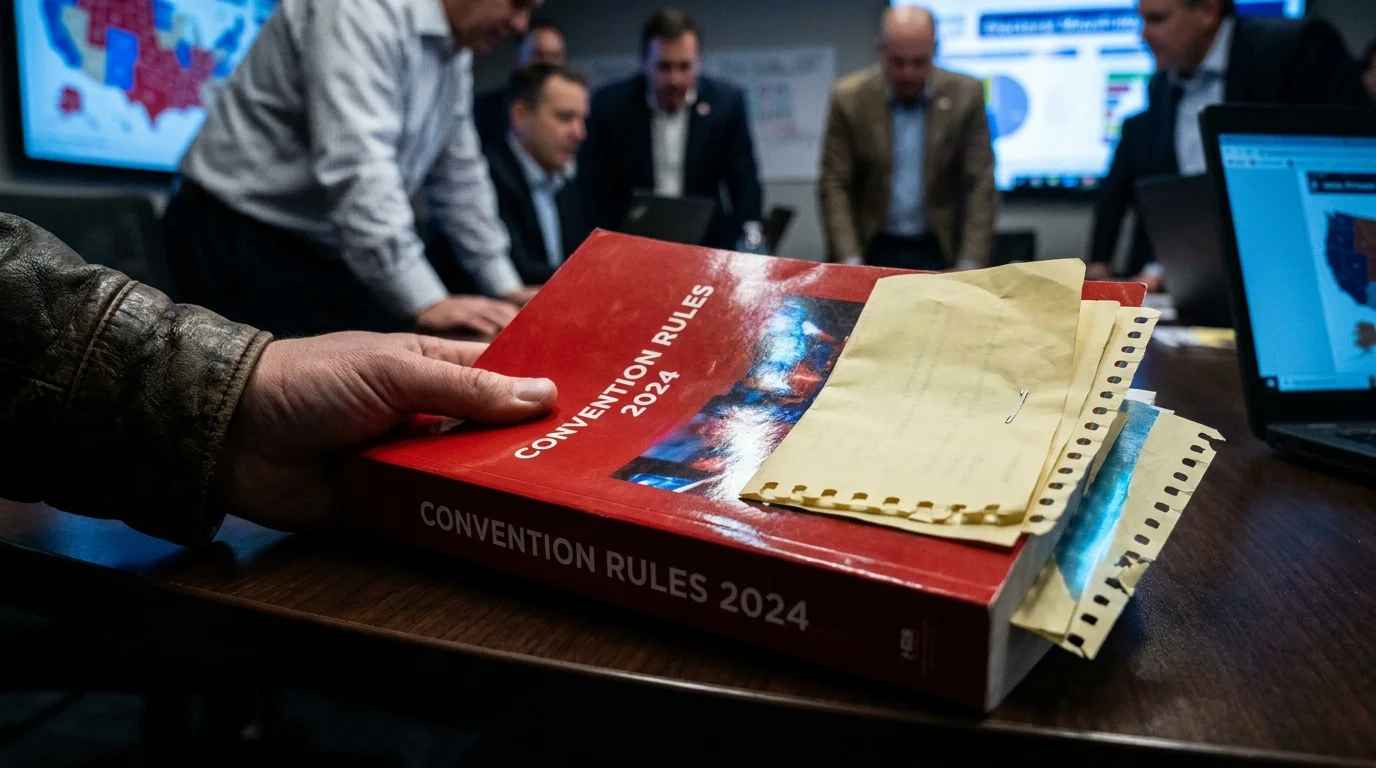
The carpet in the convention committee room smells of stale hotel coffee, industrial carpet cleaner, and forty-eight hours of recycled recirculated air. Outside the double doors, television cameras search for rehearsed soundbites, but inside, the true fight happens over paper. You can feel the physical tension in the room just by looking down at the table: sitting beside cooling water pitchers rests a glossy embossed red convention rulebook with printed draft addendum sheets stapled to the back.
Those stapled addendum sheets represent an earthquake. For forty years, the Republican foreign policy establishment treated overseas security guarantees as sacred, untouchable scripture, funding overseas bases and military assistance packages without demanding receipts from domestic factories. The consensus seemed permanently frozen in time until late Tuesday night, when an emergency floor maneuver stripped away decades of neoconservative doctrine in fewer than eighty words.
If you flip to page thirty-four of the working draft, the blue ink of the committee revision tells the entire story. In Section 4, Paragraph 12b, delegates struck through the standard pledge of unconditional foreign military assistance. In its place, the Trump delegation forced a handwritten, mandatory contingency: all future offshore defense authorizations must maintain a dollar-for-dollar domestic industrial production guarantee. The shift was immediate, unexpected, and utterly historic.
The Factory Floor as a Geopolitical Tripwire
For generations, the Washington establishment looked at foreign defense spending like an open tap. You sent appropriations abroad, allies bought hardware from multinational consortiums, and working communities in the Rust Belt waited to see if any spare change trickled down through secondary supply chains. The old doctrine viewed military intervention as a moral obligation detached from the physical health of domestic foundries.
This platform rewrite fundamentally inverts that relationship. Turning foreign alliances into manufacturing audits reframes the entire purpose of American statecraft. Under this revised platform language, overseas defense support is no longer an open-ended strategic subsidy; it functions as a rigid domestic jobs covenant. If an overseas partner requests an arms transfer or air defense battery, the appropriation will not leave the Treasury unless the tooling, casting, and precision milling happen within American borders.
To traditional defense planners, this feels like isolationism wrapped in regulatory red tape. But to industrial workers who watched machine shops shutter across the Midwest while billions flowed into overseas security contracts, it feels like basic common sense. It treats defense not as an abstract shield, but as an engine that must warm the hands of the workers building it.
The Midnight Redline in Trumbull County Terms
Arthur Vance, a 58-year-old tool-and-die technician and county delegate from Trumbull County, Ohio, spent his early morning watching the platform committee fight over every comma. Vance has worked in precision manufacturing since 1986, through three recessions and two plant consolidations, watching his union hall shrink as defense subcontracts moved to lower-cost offshore hubs.
- John Fetterman breaks party lines demanding swift domestic steel pipeline protections across manufacturing hubs
- Bernie Sanders AI legislation demands strict workplace automation bans sparking intense tech lobbying
- Voter signature verification machines reject mail-in ballot envelopes over degraded ballpoint pen strokes
- Voter turnout micro-targeting models force precinct door knockers onto very specific gravel driveways
- Suffragette picketing parade banners sparked modern street demonstrations using high contrast purple silk
“For thirty years, we were told by our own party that sending fifty billion dollars abroad kept our towns safe, even while our neighbors were pulling their children out of local schools to move south for warehouse jobs,” Vance said quietly, smoothing the curled edges of the stapled addendum. At 2:14 a.m., when the Trump delegation refused to adopt the foreign policy plank until the domestic quota was inserted, Vance knew the party he grew up with had ceased to exist. The old guard quietly surrendered their seats before dawn, leaving the new trade-linked defense language intact.
Reading the Fractures: Who Gains, Who Pays
This ideological rupture does not hit every corner of the country the same way. Understanding the impact requires looking past cable news monologues and examining how specific economic groups must adjust to this platform rewrite.
For the Domestic Precision Machinist
If you run a small foundry, a computer numerical control (CNC) workshop, or an electronics assembly shop in the Rust Belt, this platform pivot creates direct legal leverage. By conditioning foreign defense outlays on domestic production minimums, the language closes loopholes that allowed major defense primes to outsource component fabrication to foreign subsidiaries. Your shop floor becomes the primary bottleneck through which foreign defense packages must pass.
For the Traditional Cold War Internationalist
If you built your career in traditional defense diplomacy, this shift feels like an institutional fracture. Conditioning critical security pacts on domestic factory capacity strips diplomats of their ability to negotiate flexible, emergency agreements with foreign partners. In this worldview, allies under immediate regional threats cannot afford to wait for domestic supply lines to ramp up production schedules.
For the Mid-Tier Defense Subcontractor
Suppliers caught in the middle face an immediate compliance reckoning. If your supply chain relies on specialty titanium, forged casings, or printed circuit boards imported from European or Asian partners, this rewrite threatens your procurement timeline. You will need to recertify your components under strict domestic sourcing mandates or risk losing federal defense allocations entirely.
Tracking the Mandate in Your Local District
Political platforms often sound like lofty prose meant to be discarded after the balloons drop, but this specific revision comes with direct legislative teeth. You can trace its ripple effects through local payrolls, municipal contracts, and regional defense grants if you know where to look.
Instead of waiting for national headlines to decipher the impact, track these mechanical steps in your community:
- Audit your congressional representative’s votes on the upcoming National Defense Authorization Act (NDAA), watching specifically for amendments tied to domestic procurement minimums.
- Track local chamber of commerce alerts regarding Tier-2 and Tier-3 defense manufacturing subcontracts in your county.
- Monitor the Federal Procurement Data System (FPDS) for sudden shifts in foreign military sales (FMS) contract requirements awarded to local machine tooling hubs.
- Examine whether local technical colleges are expanding machinist apprenticeship grants funded through defense-adjacent federal workforce initiatives.
Your local economy responds faster than the cable news cycle. When platform language shifts from international ideological commitments to domestic industrial requirements, the money does not disappear into think tank seminars. It drops directly onto local balance sheets.
Tactical Toolkit for Following the Platform Shift
Keep these specific benchmarks and reference tools close as this policy debate moves from the convention floor to the halls of Congress:
- Draft Addendum Section 4, Paragraph 12b: The specific platform clause requiring domestic manufacturing guarantees on all offshore military authorizations.
- 10 U.S.C. § 2533a (The Berry Amendment): The federal statute governing domestic sourcing for military rations and specialty metals, which delegates used as the legal model for the floor rewrite.
- 60-Day Congressional Review Windows: The statutory timeline under the Arms Export Control Act that will now face domestic production audits before approval.
Beyond the Floor Fight: Rewiring National Value
The furious argument that echoed through the convention hall was never truly about platform semantics. It was about whether an empire’s strength lives in the global footprint of its garrisons or the humming machines of its forgotten valley towns.
When you strip away the partisan noise, the rewrite forces a profound, long-overdue perspective shift. A defense budget that hollows out its own domestic industrial base while defending foreign frontiers creates a brittle security that shatters at the first domestic economic crisis. A nation that cannot forge its own bolts cannot indefinitely protect the world.
Watching delegates leave the convention floor clutching their red rulebooks, you realize the ground has shifted permanently. Whether the traditional defense establishment likes it or not, the party’s foreign policy will no longer be drafted exclusively in foreign capitals or think-tank boardrooms. From this moment on, it will have to pass through the machine shops of Ohio, Pennsylvania, and Michigan first.
“True national security begins where the metal meets the lathe, not where the ink meets the foreign treaty.”
| Key Point | Detail | Added Value for the Reader |
|---|---|---|
| Platform Language Shift | Section 4, Paragraph 12b amended to mandate domestic industrial quotas on defense aid. | Pinpoints the exact mechanism ending unconditional foreign security spending. |
| Industrial Realignment | Directs federal military allocations back toward Midwest precision manufacturing hubs. | Helps local business owners identify upcoming federal procurement opportunities. |
| Institutional Friction | Breaks decades of neoconservative consensus on unconditional overseas military commitments. | Clarifies why established defense figures are publicly pushing back against the new platform. |
Frequently Asked Questions
Does a party platform rewrite immediately become binding federal law?
No, a party platform serves as an official governing agenda rather than statutory law. However, it establishes the non-negotiable policy framework that party leadership and committee chairs use to draft defense appropriations bills.Why did this floor amendment cause so much friction among convention delegates?
It dismantled forty years of foreign policy consensus, rejecting the traditional neoconservative belief that American foreign security spending should remain unlinked from domestic industrial production.How does this shift affect traditional defense contractors?
Prime contractors who rely on international joint ventures or offshore component manufacturing must restructure their supply chains to meet domestic assembly and machining mandates.What was the exact paragraph alteration inside the draft committee dossier?
Delegates amended Section 4, Paragraph 12b of the draft platform, replacing boilerplate military assistance pledges with strict requirements that all foreign aid have reciprocal domestic manufacturing quotas.Where will the economic impact of this change be felt first?
Tier-2 and Tier-3 precision toolmakers, foundries, and industrial machine shops across domestic manufacturing regions will see the earliest shifts in federal procurement requests.