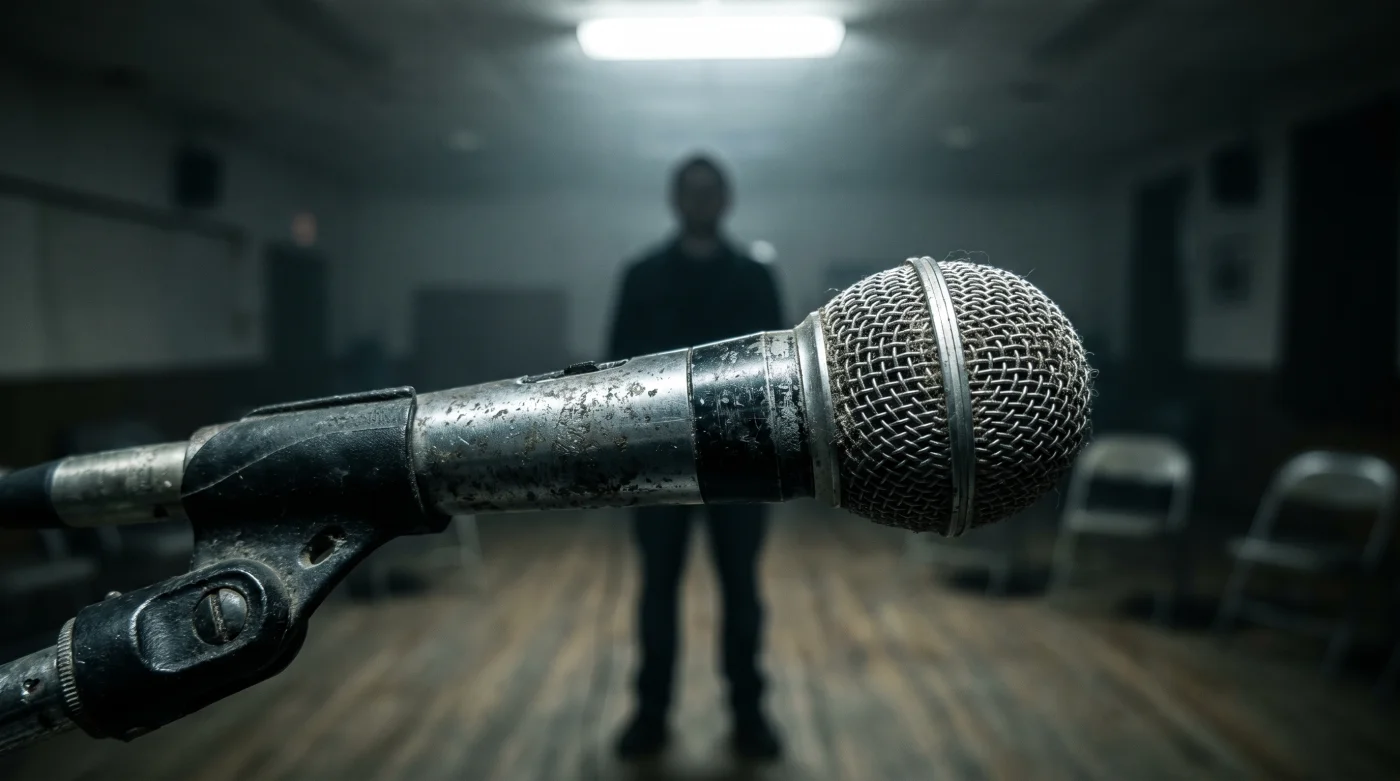
The smell of damp wool coats and stale coffee fills the room. The digital countdown timer glows bright red on the wall, marking the passage of time over the nervous tension of a room full of neighbors waiting for their three minutes at the podium. You wait your turn, shuffle your index cards, and step up to the center aisle.
You adjust the metal gooseneck, pulling the microphone toward your mouth as you begin to read your carefully prepared statement. But halfway through your most important point, as your voice rises with genuine emotion, the audio simply falls flat. The room squints, leaning forward to catch your words, but your volume has been swallowed by the overhead speakers.
We tend to blame bad municipal wiring. We assume the local community center just has ancient equipment, poor acoustics, or a volunteer who does not know how to run the audio mixer in the back row.
The suppression is entirely deliberate. What feels like a technical glitch is actually a heavily programmed soundboard preset, designed to quietly flatten unscripted public feedback before it ever reaches the ears of the council members.
The Invisible Fence of Civic Audio
Think of the modern microphone setup not as a megaphone, but as a heavily guarded tollbooth. Digital mixers use built-in compression and physical noise gates that act like heavy swinging doors. They only let sound through if it meets a very specific, calm criteria, snapping shut the moment pressure fluctuates.
This is passive institutional silencing. When your voice rises in passion, the digital compressor instantly squashes the audio signal to keep the room comfortably subdued. It is community leverage stripped away by a piece of software.
But the flaw in this digital fence is purely physical. Because these presets are calibrated for a very specific, compliant posture at the podium, you can outsmart the hardware simply by shifting where you plant your feet.
You bypass the structural barrier by refusing to engage with the equipment the way it expects you to. You can reclaim the room by understanding the algorithm.
- Highway tolls fund disparate local projects instead of road maintenance
- Paper ballots face high rejection rates due to heavy ink bleed
- Debate microphones reward audio compression tactics over actual policy substance
- Campaign flyers manipulate local crime statistics through specific baseline years
- Property tax bills hide specific administrative fees voters never approved
Marcus Thorne, a 42-year-old former touring audio engineer who now works as a municipal sound contractor in Ohio, knows exactly how the deck is stacked. Marcus routinely programs the digital soundboards for county zoning boards and school districts, and the requests from city managers are always identical.
They demand broadcast safe presets. Marcus explains that local governments hate sudden dynamic shifts. He programs tight noise gates that shut off the mic if someone pauses too long, and heavy limiters that kill the volume if a citizen gets too close and triggers the bass-heavy proximity effect. The board reads that low-end rumble as a distortion threat and instantly pulls the digital fader down. It is an acoustic glass ceiling built for dissent.
Adjusting Your Stance for the Room
You have to treat the community podium like a tactical environment. How you handle your body in relation to the equipment completely dictates how much of your message actually survives the trip to the speakers.
For the Prepared Orator, if you are reading directly from a printed statement, your physical instinct is to look down. This drops your chin, collapsing your airway, and forces your voice into your chest, entirely missing the microphone pickup pattern. The heavy noise gate will simply ignore you. You have to hold your notes up at eye level, projecting past the metal grille.
For the Emotional Advocate, when adrenaline hits during a heated debate, you naturally lean forward. You might grip the edges of the wooden stand or pull the microphone right up to your mouth.
The system punishes aggressive proximity. By getting too close, you trigger the exact volume capping Marcus warned about. The harder you push into the mic, the more the algorithm restricts your output, turning a passionate plea into a muffled, distant drone.
For the Soft-Spoken Neighbor, if your natural speaking voice lacks a booming low end, the digital noise gate will assume you are just ambient room noise shuffling papers.
You must speak with percussion. You do not need to scream, but you must speak with a sharp, rhythmic cadence to force the digital gate to recognize you as a legitimate, continuous audio signal.
Bypassing the Physical Noise Gate
To circumvent the automated silencing, you must completely change your spatial relationship with the hardware. The secret to maintaining your community influence lies in taking a literal step back from the focal point.
Stand three feet away. By stepping exactly thirty-six inches back from the microphone capsule, you bypass the compressor activation threshold entirely. At this distance, the harsh bass frequencies dissipate in the air before hitting the sensor, preventing the system from automatically capping your volume.
Your voice balances out naturally, forcing the system to treat you like ambient room sound that must be picked up, rather than a close-range threat to be suppressed. Here is your tactical toolkit for your next local meeting:
- Measure your footprint: Plant your feet roughly three feet from the base of the stand. Resist the urge to crowd the wood.
- Project to the back wall: Look entirely over the heads of the council members. Aim your voice at the exit sign.
- Maintain a steady pressure: Do not whisper and then suddenly shout. Keep your volume firmly at a seven out of ten.
- Ignore the dead air: If the mic briefly cuts out, do not lean in. Keep your position and your projection. The gate will reopen on its own.
- Breathe from the floor: Support your voice from your stomach, not your throat, to keep a consistent air pressure against the mic.
Reclaiming the Volume of the Room
You dictate your own presence. Local politics is rarely decided by the sheer brilliance of a written argument submitted in a folder. It is decided by who commands the physical attention of the room when the clock is ticking and the tension is high.
When the municipal audio infrastructure is quietly working to smooth out the rough edges of community dissent, knowing how to physically bypass those limits becomes a profound act of leverage. You are no longer at the mercy of an invisible algorithm designed to make your frustration sound perfectly palatable.
Your voice remains distinctly yours. By taking half a step back and projecting with intention, you force the room to meet you on your own terms. Your feedback remains uncapped, unfiltered, and ringing clearly off the back wall, exactly as you intended it to be heard.
The soundboard is programmed for a polite conversation; if you bring passion to the mic, you have to trick the hardware into thinking you are just ambient room noise.
| Key Point | Detail | Added Value for the Reader |
|---|---|---|
| Proximity Effect | Bass frequencies spike when you stand too close to the microphone. | Prevents the system from triggering sudden volume drops. |
| Noise Gate Threshold | The minimum acoustic pressure required to activate the audio feed. | Ensures soft-spoken voices do not get accidentally cut off. |
| The Three-Foot Rule | Standing 36 inches back stabilizes your acoustic output. | Bypasses institutional volume capping entirely, maintaining your leverage. |
Common Meeting Audio Frustrations
Why does my voice sound muffled during public comment? Audio engineers set limiters to cap sudden volume spikes; if you lean in too close when speaking passionately, the system actively suppresses your volume.
Can I just speak louder to fix the microphone? No. Speaking louder into a gated microphone triggers heavier compression. You must step back, not shout louder.
What if I have a naturally quiet voice? Do not lean closer. Maintain a sharp, rhythmic speaking style to keep the digital noise gate open without triggering the proximity effect.
Will stepping back make me harder to hear? Actually, it balances your voice. By stepping back, your voice travels as an even sound wave rather than a concentrated blast of air, bypassing the audio limiters.
Do organizers do this on purpose? Yes. Municipalities request broadcast-safe audio presets to prevent feedback and maintain a specific sense of decorum, which passively acts to silence unscripted emotion.