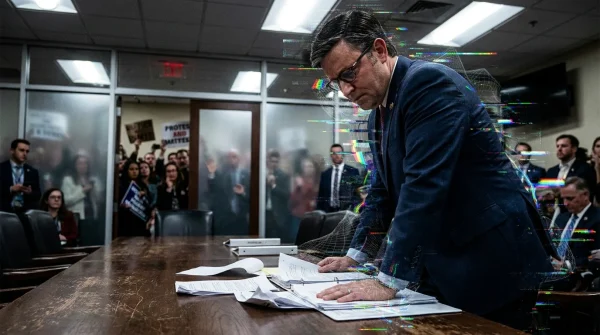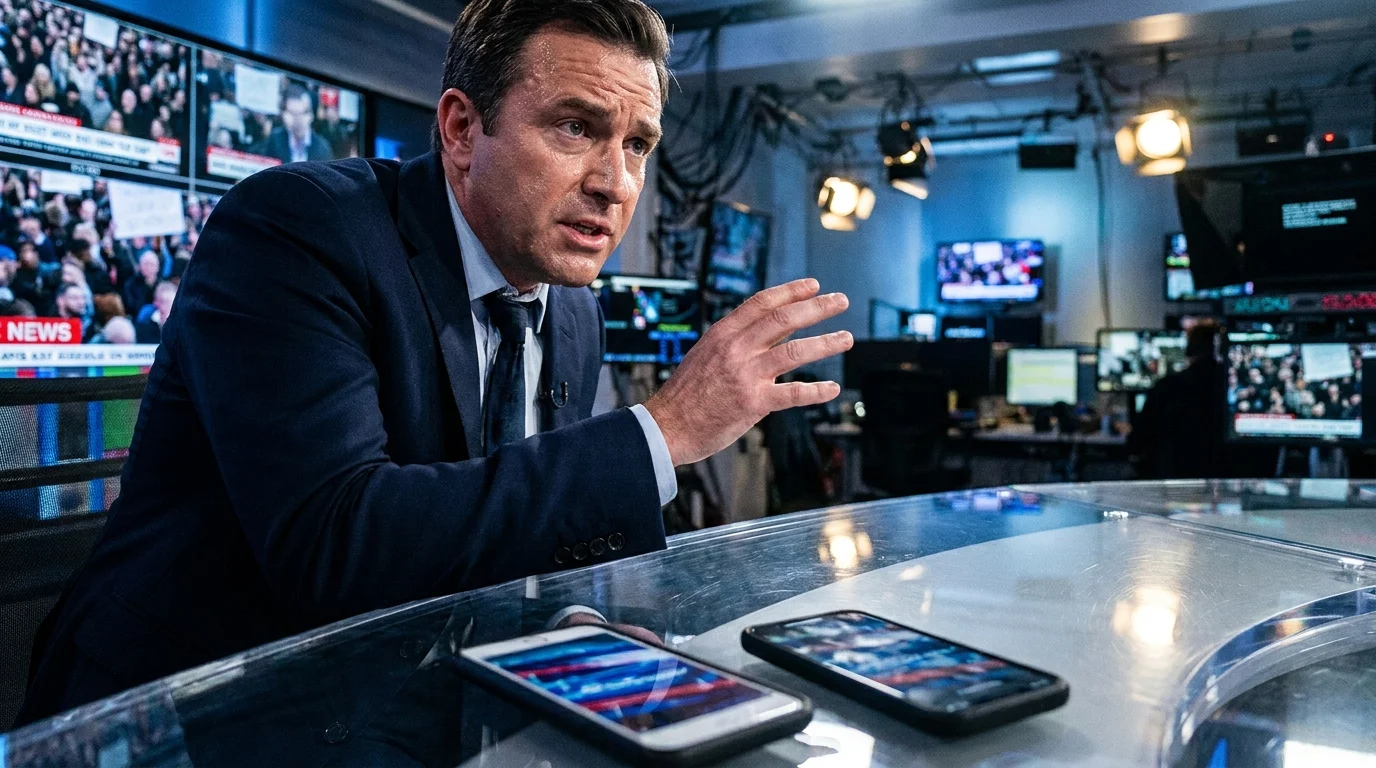
The late afternoon sun over the county fairgrounds leaves the concrete radiating a dry, heavy heat that smells of ozone, diesel exhaust, and kettle corn. You sit on the tailgate of your truck or at your kitchen counter, staring down into the palm of your hand where glaring smartphone screens reflect flickering red and blue live-stream banners. On your screen, the candidate grips the lectern with both hands, shouting above a deafening roar of brass air horns and rustling gold-and-black local union placards.
Depending on which algorithmic feed caught your thumb first, you are witnessing two entirely separate historical events happening on the exact same patch of grass. In one tab, the broadcast camera pulls so close that the frame groans under the weight of human shoulders, packing hardhat decals and embroidered union jackets into an impenetrable wall of blue-collar momentum. The comments cascade at breakneck speed, celebrating an unstoppable wave of working-class solidarity.
Then you flick your thumb upward. A rival partisan account broadcasts an unauthorized drone angle hovering five hundred feet above the outfield fence. From this icy, detached vantage, the fiery rally shrinks into a fragile, fenced-in horseshoe of four hundred folding chairs clustered around a rental stage, surrounded by acres of barren, parched grass and cavernous, rusted grandstands holding little more than windblown wrappers and bored security guards.
You are caught in the reality split. The discrepancy is not an accident of amateur filming; it is the calculated byproduct of modern visual staging, where political enthusiasm is no longer measured by how many neighbors you convince to walk through a turnstile, but by how skillfully a production crew can manipulate the optical physics of focal length.
The Focal Length Illusion: Why Your Feeds Never Agree on the Room
When you watch campaign stops through digital glass, you are rarely seeing an unvarnished room; you are looking through an ideological lens designed to either compress human bodies together or isolate them in cold space. The primary weapon in this narrative war is optical compression, an optical trick as simple as changing a camera lens from an eight-millimeter wide-angle to a two-hundred-millimeter telephoto.
A telephoto lens flattens space. It pulls the distant background forward, collapsing twenty feet of empty walkway between folding chairs until the gaps vanish completely, rendering a scattered assembly as an unbroken wall of flesh. Conversely, an extreme wide shot exaggerates distance, making twenty yards of open grass look like an abandoned desert. In the modern news cycle, focal length dictates voter enthusiasm before the speaker even clears their throat.
- Grants Pass homelessness rulings derail municipal cleanup teams leaving heaps of shredded canvas tents
- Brazilian steel tariff hikes stop Midwestern farm equipment factories under soaring metal costs
- Raw dairy distribution waivers enforce sudden regulatory rollbacks across state milk inspection boards
- Ohio rust belt primary slates switch union endorsements away from longtime congressional incumbents
- Federal culvert drainage mandates force rural county budgets into emergency property tax spikes
Dan Mercer, 46, a veteran broadcast pool camera operator who has rigged risers for five presidential cycles across the industrial Midwest, knows this choreography down to the second. “Every advance team gives us the exact same layout sheet,” Mercer shared during a load-in at an idle assembly plant outside Youngstown. “They shove the loyalists into a tight, six-foot crescent directly behind the podium to catch the teleprompter glow, and they keep the perimeter lights completely cut so the shadows swallow the empty bleachers. If an independent feed cuts to the high-angle ceiling cameras before the speech ends, the network phone rings in ten seconds flat.”
Deconstructing the Feed: The Three Lenses of Campaign Coverage
To avoid being manipulated by optical framing, you need to understand how rival production outfits tailor their live feeds for specific emotional outcomes across your timeline.
1. The Telephoto Squeeze: The Incumbent’s Fortress
This strategy relies on tight, waist-up framing of the speaker, crowded by a curated wall of campaign t-shirts directly over their shoulders. By eliminating the horizon line and banishing empty floor space, the feed manufactures an atmosphere of claustrophobic popularity. Every nod feels universally validated because the frame denies the viewer any negative space where indifference could live.
2. The Drone Expose: The Challenger’s Mirage
Opposing campaigns and independent agitators deploy high-altitude drone footage or rear-arena wide shots to pierce the production illusion. These angles focus obsessively on perimeter fencing, early departures, and empty metal folding chairs. While technically factual, these shots intentionally scrub away the localized energy at the front of the stage, converting authentic neighborhood passion into a statistical failure.
3. The Algorithmic Soundbite: The Pocket Echo
Vertical video feeds crop the horizontal broadcast frame even further, stripping out seventy percent of the room. A clip shared on social feeds isolates only the speaker’s furrowed brow and the auditory surge of a single loudspeaker. Sound design masks empty floorboards by boosting line-level audio direct from the soundboard while viewers assume the roar represents ten thousand roaring voters standing shoulder to shoulder.
Mindful Decentering: How to Audit a Rally Stream in Real Time
Escaping this optical trap does not require media theory credentials. It requires treating political video not as a reflection of truth, but as deliberate set design. You can ground your perspective using basic visual forensics.
- Locate the Fixed Architecture: Disregard the sea of moving placards and search the edges of the frame for fixed arena fixtures, such as exit signs, scoreboard numbers, or outfield yardage markers. These permanent landmarks instantly reveal the true depth of field and expose optical lens compression.
- Audit the Soundboard Spill: Pay attention to the acoustic decay of the speaker’s voice. A packed indoor hall produces rapid, muffled acoustic absorption, while an empty municipal arena creates a hollow, metallic slap-back echo between syllables.
- Track the Eye Lines: Watch where the speaker looks during applause breaks. If their gaze sweeps a narrow ninety-degree arc, they are addressing a tiny, stage-managed cluster; genuine arena-filling momentum pulls a speaker’s chin across a sweeping two-hundred-degree horizon.
- Check the Perimeter Shadows: Look past the brightly lit VIP risers into the background corners. If the venue lighting drops abruptly into pitch blackness just twenty feet behind the riser, the production team is intentionally hiding unreserved seating.
The Bigger Picture: Reclaiming Your Grip on Common Reality
The danger of conflicting attendance feeds is not merely that one campaign looks stronger than it actually is. The true damage happens inside your own nervous system. When two neighbors look at the same Labor Day address and see entirely irreconcilable realities—one seeing an unstoppable groundswell, the other a humiliating ghost town—the possibility of shared political conversation collapses.
Understanding camera positioning restores your agency. When you recognize that focal lengths are being weaponized to manufacture synthetic momentum or artificial isolation, the fever dream of digital politics cools down. You stop mistaking optical tricks for the heartbeat of your community, and you begin evaluating candidates by the durability of their policies rather than the choreography of their camera risers.
“The camera does not lie about what it sees, but it tells whatever story the person choosing the lens wants to whisper in your ear.”
| Key Point | Detail | Added Value for the Reader |
|---|---|---|
| Telephoto Compression | Focal lengths above 135mm flatten physical distance between subjects. | Helps you spot when a small cluster of supporters is framed to look like a massive crowd. |
| High-Altitude Bleed | Wide drone angles maximize empty ground and downplay stage density. | Prevents opposing political operatives from convincing you that genuine local enthusiasm is entirely fabricated. |
| Acoustic Slap-Back | Reverberation times in arenas reveal actual room occupancy faster than visuals. | Gives you an objective sensory check that visual staging teams cannot easily disguise on live feeds. |
Frequently Asked Questions
Why do political advance teams keep the venue lights dim behind the crowd?
Cutting arena ambient light forces broadcast cameras to close their apertures, which drops underexposed empty bleachers into total blackness and keeps the viewer focused exclusively on the lit crowd near the stage.Are drone shots of campaign rallies legally permitted?
Most major campaign stops operate under strict FAA Temporary Flight Restrictions (TFRs) for candidate security, meaning unauthorized drone clips circulating online are often captured from miles away using telephoto drone lenses or shot outside the restricted perimeter.How can I find the official attendance count for a union rally?
Local municipal fire marshals issue official occupancy permits and maximum capacity ratings for venues, which offer an objective baseline far more reliable than estimates released by either the campaign or rival super PACs.Does microphone placement alter how big a crowd sounds online?
Yes. Microphones pointing directly at the front row pick up immediate, isolated cheers and blend them directly into the broadcast line feed, artificially exaggerating the perceived volume of the entire venue.Why is crowd size such a fierce battlefield during Labor Day stops?
Labor Day traditionally marks the psychological kickoff of autumn campaign pushes, where demonstrating organic union enthusiasm is critical for unlocking volunteer mobilization and digital small-dollar fundraising.