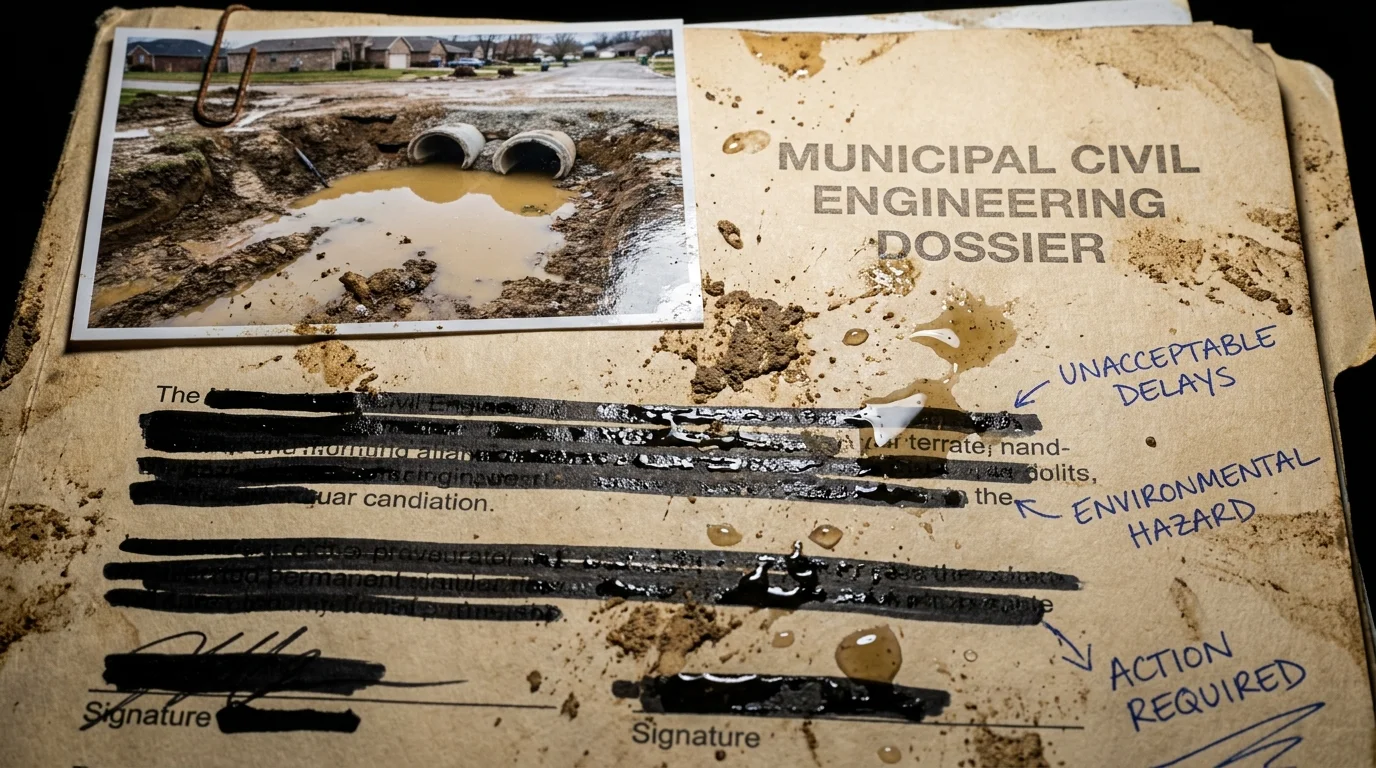
A sharp tang of iron-rich subsoil hangs over the backyards of the new subdivision. Fifty yards past your patio, a yellow excavator sits frozen on crushed limestone tracks, rain drumming against its cold diesel cab. Between the manicured sod and the surveyor’s orange ribbons lies an open, ragged gash: four hundred feet of raw red clay carved out to receive concrete storm culverts, now collecting gray runoff that has nowhere left to run.
Instead of a functional stormwater channel designed to keep your crawl space dry, you are left staring at a muddy stagnant water trench humming with the first hatch of summer mosquitoes. The workers left three Tuesdays ago, leaving behind rolls of black geotextile fabric and half-driven rebar stakes. The neighborhood expected finished grading before the heavy spring rains; what you inherited was an accidental moat holding two feet of soupy, trapped water.
The silence from the work site feels personal, like a contractor dispute or a local budget shortfall. Yet the equipment did not stop moving because the county ran out of gravel or fuel. The crews packed their hand tools because nine people in Washington redrew an invisible boundary across the continent, instantly turning routine municipal earthworks into a legal minefield.
The Phantom Line Between Soil and Stream
For decades, water infrastructure moved through a settled administrative rhythm. If a county civil engineering department needed to cut a drainage ditch through a low-lying pasture to protect twenty new homes from basement seepage, they followed an established playbook. They filed for federal permits under the Clean Water Act, assuming that if water flowed across land and eventually reached a navigable creek, the Army Corps of Engineers had the final say. That predictability acted like a steady municipal pulse.
Then came the Supreme Court’s verdict in Sackett v. EPA, and the regulatory circuit breaker tripped overnight. By discarding the long-standing significant nexus test—a standard that weighed whether an isolated wet pocket chemically or ecologically affected downstream rivers—the court demanded a continuous surface water connection. Suddenly, water that only appears when the clouds burst no longer clearly exists under federal protection, nor does it sit neatly under local exemption.
This shift sounds like straightforward deregulation on paper, but on the ground, it triggered immediate municipal paralysis. Local engineering boards found themselves caught in a jurisdictional vacuum where neither state environmental departments nor federal field officers were willing to sign off on active ground disturbances. If a city backhoe digs through an unverified wetland pocket to connect a neighborhood drainage pipe, does the municipality risk a federal lawsuit, or are they abandoning state-level riparian protections? Faced with personal civil liability, county directors simply ordered their operators to cut the engines.
- Walgreens retail prescription policies spark furious state boycotts leaving locked glass display cases
- Bureau of Land Management relocations enforce staff exoduses leaving dusty desert field desks
- Canadian softwood lumber tariffs strip regional builders leaving damp pine frame skeletons
- Seed oil restaurant ban proposals derail county health inspections over scorched cooking grease
- Working Families Party primary slates demand veteran seat surrenders across scuffed gymnasium floors
Elena Vance, 52, a lead stormwater coordinator in suburban Gwinnett County, spent the morning of the ruling red-tagging her own department’s capital improvements. She had spent three years securing easements, designing retention basins, and modeling runoff volumes for a critical bypass ditch meant to relieve chronic yard ponding. By noon, her legal counsel instructed her to halt four active work sites mid-excavation because the Corps paused its approved jurisdictional determinations. Her crews climbed down from their machines, leaving half-channeled swales to erode into the very yards they were sent to protect.
How the Regulatory Void Splits Your Neighborhood
The sudden retreat of federal oversight does not eliminate stormwater; it merely strips the rules that told contractors where that water was allowed to go. As municipal lawyers debate the wording of newly issued agency memos, suburban neighborhoods are fracturing into distinct infrastructure battlegrounds based entirely on when their foundations were poured.
The New Master-Planned Perimeter
In freshly graded developments, private homebuilders are caught between municipal occupancy permits and frozen regional environmental clearances. You see half-dug retention ponds sitting dry while the collector trenches leading to them are barricaded with orange plastic fencing. Because developers cannot get quick sign-offs on whether roadside swales count as protected tributaries, grading permits remain frozen, pushing move-in dates back months while site runoff cuts jagged rills across unfinished streets.
The Established Mid-Century Suburb
For subdivisions built in the late 1970s, the crisis looks like failing, corroded corrugated metal pipes that no one can legally replace. When an old underground pipe collapses beneath a backyard easement, digging it up now requires proving the surrounding saturated soil does not hold an unregulated surface seam. Public works departments that once repaired these failures in forty-eight hours now place steel plates over street sinkholes, leaving the adjacent open ditches to pool with brackish water while local administrators wait for updated regional field guidance.
The Exurban Fringe and Roadside Easements
Along county highways where subdivisions bleed into pastureland, roadside ditches double as primary flood management. Here, the paralysis is acute. County road crews have paused seasonal ditch clearing—scraping away cattails, silt, and invasive brush—fearing that altering the natural flow of a newly unclassified ditch could provoke citizen suits from downstream landowners or environmental groups monitoring the legal fallout. The result is miles of choked gravel channels that back up into neighborhood access roads during forty-minute cloudbursts.
Navigating the Stalled Trench in Your Backyard
When the heavy machinery leaves your property line and the municipal updates stop coming, you cannot afford to wait out a multi-year judicial reconciliation. You have to actively defend your foundation, your topsoil, and your family’s health from the water trapped behind bureaucratic hesitation.
Start by treating the stagnant ditch as an active construction site rather than a finished drainage feature. Document every structural change in your soil perimeter weekly using clear photos and a basic measuring stake driven into the center of the pool.
- Inspect the contractor silt fences along your boundary line; if black geotextile fabric is ripped or sagging under mud loads, request immediate site stabilization from your town building inspector.
- Place non-toxic biological mosquito dunks containing Bacillus thuringiensis israelensis directly into standing pools older than forty-eight hours to halt insect cycles without contaminating groundwater.
- Check your home foundation perimeter using a hand-held soil probe to ensure subterranean saturation is not migrating toward your footing drains or basement walls.
- Organize a single, coordinated inquiry with your local council representative, focusing specifically on public nuisance and health codes rather than federal environmental status.
The Tactical Drainage Toolkit
Keep these baseline numbers handy when assessing the water accumulation outside your back door:
- Standing Water Threshold: 72 hours maximum before stagnant water becomes an active vector hazard requiring municipal code intervention.
- Silt Fence Anchor Depth: 6 inches minimum buried in a vertical trench to prevent sediment undercutting during heavy rain.
- Soil Saturation Pressure: Hand penetrometer readings falling below 100 PSI within five feet of your foundation signal structural moisture migration.
- Slope Drop Ratio: Finished swales require a minimum 1-inch fall per 10 feet of run to prevent permanent pooling in clay soils.
The Architecture of Local Gravity
We tend to think of monumental judicial shifts as abstractions—debates captured in leather-bound volumes, argued by lawyers in immaculate suits under vaulted ceilings. But gravity does not read legal opinions. Rain falls with the same careless weight whether the ground below is classified as an adjacent wetland or a private ditch.
When federal guidelines snap back like an overstretched rubber band, they do not create instant freedom; they create local hesitation. That hesitation sits outside your window right now as red clay soup, soaking through roots, rotting grass, and breeding insects. Reclaiming your peace of mind means seeing that muddy trench for what it really is: a temporary pause in civic responsibility that demands your quiet, informed vigilance until local engineers find their footing on the new terrain.
The sharpest changes in federal doctrine are rarely felt in courtrooms; they are measured in the inches of standing water left along suburban property lines.
| Key Point | Detail | Added Value for the Reader |
|---|---|---|
| Regulatory Shift | Replacement of significant nexus with continuous surface connection standard. | Explains why contractors stopped mid-build despite having local blueprints in hand. |
| Municipal Risk | Civil liability fears halt county public works and Section 404 nationwide permits. | Helps you identify whether delays stem from funding or regional legal paralysis. |
| Property Protection | Immediate intervention thresholds for sediment, standing water, and vector control. | Gives you concrete metrics to force local health and building code enforcement. |
Frequently Asked Questions
Why did the road crew abandon my neighborhood drainage ditch halfway through digging?
Municipal crews frequently pause earth-moving operations when environmental permit definitions change abruptly, leaving local engineers legally uncertain whether cutting into wet soil requires federal approval or exposes the county to costly lawsuits.How long can a contractor legally leave standing water in an unfinished swale?
Most local municipal codes designate standing, stagnant water as a public health nuisance once it remains motionless for more than 72 hours, regardless of pending environmental permit reviews.Does the Sackett ruling mean developers can build over any wet ground now?
No, while federal Clean Water Act jurisdiction was narrowed, state-level environmental protections, local zoning laws, and county stormwater ordinances remain fully active and often require their own separate approvals.Will stagnant runoff in an unfinished municipal trench damage my home foundation?
If saturated clay sits within ten to fifteen feet of your foundation for several weeks, hydro-static pressure can build against basement walls and overwhelm residential footing drains, risking basement dampness.What is the fastest way to get an abandoned drainage trench secured?
Contact your municipal code enforcement or vector control office rather than the road department; public health and safety violations regarding standing water carry faster enforcement power than stalled infrastructure permits.