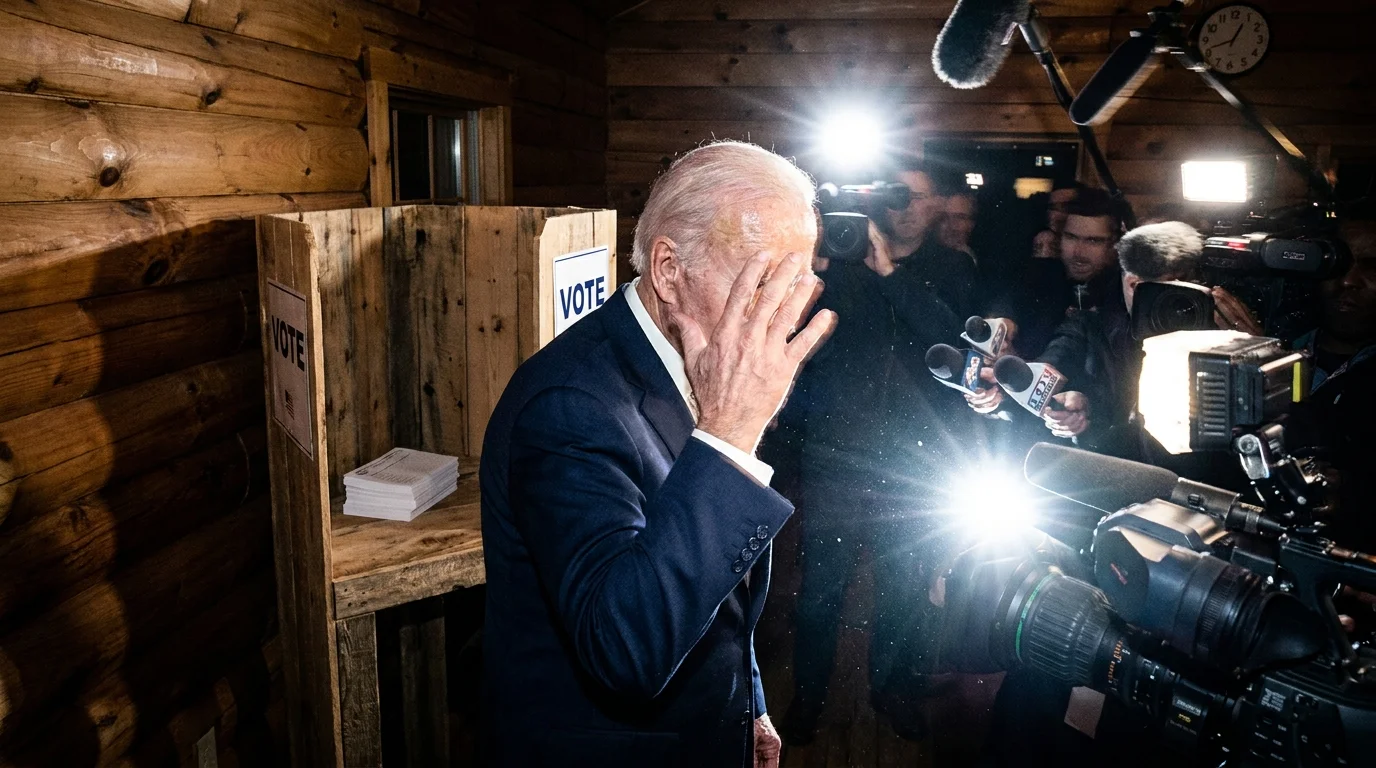
Step past the heavy oak door of the Ballot Room at the Balsams Grand Resort, and the biting sub-zero wind of Coos County instantly yields to the smell of aged pine and wool coats. Outside, the New Hampshire ridgeline sits black against a blinding mantle of January snow. Inside, the quiet is almost monastic. You hear the rhythmic hum of an old cast-iron radiator, the scrape of boots on worn floorboards, and the soft slide of a cedar curtain ring along a brass rod.
You are looking at hand-carved cedar voting booths, smoothed down by decades of nervous thumbs and pencil leads. While the rest of the nation sleeps under the soft blue flicker of idle phones, six people gather here under low-hanging timber beams. They do not use touchscreens or optical scanners; they take a folded slip of heavy paper, step behind unfinished mountain timber, and make an ordinary pencil mark in the dark.
By 12:03 AM, the small wooden ballot box is empty, tipped upside down on green felt to prove nothing hides in its corners. It looks like an antique parlor game, a quaint relic preserved for postcard racks and local pride. Yet five hundred miles south, inside fluorescent-lit boiler rooms across Northern Virginia, television screens flare white with urgent breaking chyrons.
Before the ink even dries on the handwritten tally board, war rooms burn cash reserves across hyper-targeted search corridors to redirect the national narrative before the morning commute.
The Whispering Bell Tower: Why Six Ballots Move Millions
You have likely been told that modern presidential races are won in the dense concrete rings of suburban Atlanta or sprawling tract developments outside Phoenix. The official playbook insists that early momentum is a science of demographic spreadsheets, door-knock ratios, and focus-group sentiment tracking. But watching national campaign managers react to Dixville Notch is like watching an artillery crew flinch at a firecracker in a quiet canyon.
Think of the national political apparatus not as an impenetrable fortress, but as a silent bell tower. A whisper at midnight inside a ski lodge does not sway millions of minds because of its statistical weight; it echoes because there is no other noise in the room to compete with it. For five critical hours, between midnight and dawn, Dixville Notch is the only empirical fact on the American electoral ledger.
When a candidate fails to capture a clean sweep of six rural ballots, ad algorithms recalibrate immediately across battleground search feeds. Campaign consultants who preach data-driven discipline suddenly succumb to superstitious dread, terrified that a three-vote split will become the breakfast chyron framing their candidate as weak on retail grit.
- ActBlue smart tip popups trap small donors behind tiny glowing blue sliders
- Office of Legal Counsel memos block expansive presidential directives behind red wax stamps
- Senate Legislative Counsel redlines derail midnight compromise packages with hurried pencil strikes
- Debate podium countdown clocks force sudden candidate stumbles under blinking amber numerals
- Quinnipiac University phone rosters strip working voters under crackling cell audio filters
The Man Who Keeps the Pencils Sharp
Tom Tillotson, a 72-year-old mountain engineer who has watched midnight voting from the Ballot Room since he was a boy, does not care about digital ad buys or television panic. Standing beside the hand-carved cedar partition, he checks the lead on every single number-two pencil with his thumbnail, ensuring not one point snaps under a voter’s nervous hand. Tom understands that the ritual survives because of its deliberate friction—the physical weight of wood, paper, and neighborly accountability that Washington consultants spend their entire careers trying to digitize.
Deconstructing the Pre-Dawn Panic Layers
The moment those midnight votes register on live broadcast feeds, the modern campaign machine splinters into three frantic, automated reactions. You can understand where the money goes by breaking down who panics first:
The Rapid-Response Comm Floor: Their goal is pure spin containment. If their principal loses even two of the six votes, the morning press memos must pivot instantly to dismiss New Hampshire’s idiosyncratic nature, drafting counter-narratives before the morning network anchors take their desks.
The Micro-Targeted Digital Desk: With cable panels analyzing a tiny cedar booth, programmatic ad budgets spike across early-voting state zip codes. Digital directors rush to flood local search feeds with upbeat candidate bios to drown out early morning doubts.
The State Field Director: For staff sleeping on church basements and borrowed couches in Manchester, Dixville is a sudden morale hazard. A surprise midnight deficit means rolling out of bed at 4:30 AM to send urgent mass texts to district captains, begging for increased turnout at regular morning polling stations.
Filtering the Noise: Your Midnight Election Protocol
When you see midnight primary numbers flashing across your feed, you are looking at political theater designed to provoke emotional investment. You do not need to let midnight theater hijack your morning peace. Treat the early returns not as an omen, but as a fascinating artifact of retail democracy.
Keep your focus grounded by observing the ritual rather than buying into the artificial panic:
- Recognize the sample size: Fewer than ten people in a mountain notch do not represent a three-hundred-million-person country.
- Impose a morning delay: Avoid opening campaign reaction threads until at least 9:00 AM, allowing cable panic to burn off its initial hysteria.
- Watch the ad transparency logs: Notice how major campaign accounts dump emergency budget into retail-focused search terms immediately following midnight tallies.
- Appreciate the hand-carved craft: Find value in the physical integrity of neighbors gathering around cedar partitions, even as modern consultants try to weaponize the outcome.
Your tactical toolkit for election morning requires simple boundaries: a hard fifteen-minute timer on early news feeds, a quiet cup of coffee before checking social sentiment, and a steady refusal to mistake early media oxygen for actual voter consensus.
The Quiet Dignity of Wood and Paper
There is a strange, protective beauty in the fact that six votes cast in an old resort room still manage to rattle modern political machines. Despite billions spent on predictive models and social sentiment scrapers, campaigns remain desperately vulnerable to the simple dignity of neighbors dropping paper slips into a wooden box.
When you step back from the manufactured urgency, you realize the cedar booths of Dixville Notch do not belong to the television producers or the political action committees. They belong to the stubborn human impulse to stand in a quiet room, cast a private ballot in the dark, and make the powerful wait until the count is done.
The loudest campaign machines in the world will always tremble before six neighbors standing quietly around a wooden box at midnight.
| Key Point | Detail | Added Value for the Reader |
|---|---|---|
| Sample Size Distortion | Dixville Notch rarely exceeds a dozen registered voters at midnight. | Helps you maintain perspective when cable networks frame split votes as national landslides. |
| Algorithmic Ad Spikes | Campaign war rooms shift programmatic digital ad dollars within minutes of the midnight tally. | Reveals how early media narratives directly manipulate the political ads appearing in your personal feed. |
| Physical Ballot Integrity | Voters use hand-carved cedar booths, paper ballots, and pencil marks without electronic tabulators. | Restores appreciation for simple, verifiable democratic traditions over hyper-digital campaign machinery. |
Frequently Asked Questions
Does Dixville Notch always accurately predict the eventual winner?
No. The town’s midnight vote is an early indicator of local enthusiasm and media momentum, but its tiny voter base frequently splits or swings toward candidates who do not win the broader national primary.Why are voters allowed to cast their ballots at midnight?
New Hampshire state law permits any precinct to close its polls as soon as 100% of its registered voters have cast their ballots, making midnight voting a compliant, time-honored local tradition in tiny mountain hamlets.Why do campaigns spend money responding to so few votes?
Because Dixville Notch provides the only live electoral result between midnight and 6:00 AM, campaigns spend heavily to shape the cable news chyron that millions of waking voters see over their morning coffee.How long has the Balsams lodge hosted this midnight tradition?
The tradition began in 1960 under hotelier Neil Tillotson, serving as an ingenious way to secure international publicity for the remote ski resort while honoring local civic duty.Will recent primary calendar changes end the midnight vote?
While national parties continue to contest and reorder state primary calendars, New Hampshire state statute mandates that its primary retain its first-in-the-nation status, keeping the midnight ritual fiercely protected by local officials.