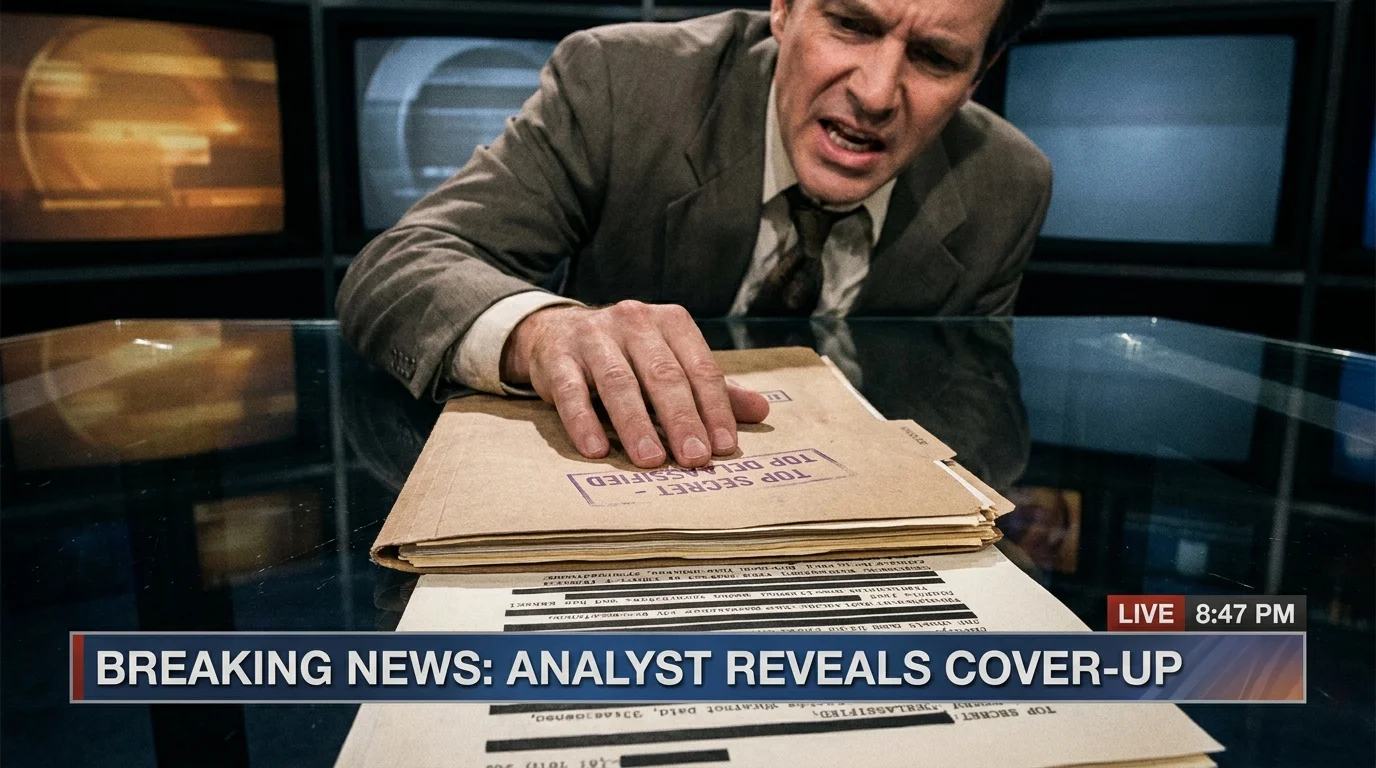
The reading room in College Park smells of dry pulp, iron gall ink, and sixty years of recirculated air. When the clerk slides the carton across the laminate desk, it lands with a dead, heavy thud. Inside rests a thick manila folder stamped with faded purple declassification seals, its brass fasteners rusted orange against the cardstock.
You turn the leaf expecting crisp, blacked-out bars—the familiar redaction geometry of modern intelligence disclosures. Instead, you find pages where grease pencil lines have begun to flake away, exposing carbon-copy transcripts typed on manual Underwoods in windowless field offices.
Most people assume modern domestic monitoring was born in the blinking server racks of the early two-thousands. You are taught that mass data collection is an artifact of fiber-optic cables, cellular towers, and complex metadata algorithms. But as your fingers trace the indented margins of these freshly unsealed Church Committee binders, the digital myth dissolves.
The architecture of civilian monitoring was not invented by silicon; it was built by hand, carbon ribbon by carbon ribbon, long before the internet existed.
The Analog Panopticon: Rerouting the Historical Blueprint
To understand the Church Committee binders, you have to discard the idea that surveillance requires high-speed computing. Think of Cold War surveillance not as an algorithmic net, but as an endless plumbing system. Every copper telephone wire leading into an apartment building in Chicago, Detroit, or Atlanta was a pipe that could be tapped, drained, and transcribed into three-ring binders.
When Senator Frank Church convened his select committee in 1975, investigators cracked open an apparatus that ran on index cards, grease pencils, and overnight couriers. The newly unsealed appendices show that field agents were not just tracking foreign adversaries; they were listening to kitchen-table arguments, school board campaign plans, and church basement anti-war meetings.
The real shock in these unredacted margins is the sheer mundanity of the targets. You see line items documenting the purchase of mimeograph paper by suburban peace advocates alongside transcripts of late-night calls between civil rights organizers. The state was not hunting hidden weapon depots; it was mapping ordinary civic discontent.
- Mojtaba Khamenei succession reports force polarized television analysis across competing foreign networks
- Marco Rubio immigration rulings trigger starkly divided cable headlines across rival networks
- Suburban school rezoning maps spark sudden tax revolts across affluent swing districts
- Daniel Richman memo leaks expose coordinated foreign bot networks fabricating federal warrant records
- Loper Bright Chevron rulings block county river cleanup projects across contaminated industrial districts
In the quiet aisles of the National Archives, Martha Vance, a 62-year-old archival researcher and former legislative aide, spent seven months cross-referencing Box 44 with regional FBI field memos. Her breakthrough came not from the typed body text, but from the unredacted penciled margins on page 412 of Binder Five. There, a field agent had scribbled: “Subject’s grocery delivery delayed 2 hrs—monitored conversation with grocer regarding credit.” As Vance noted, seeing that level of micro-interference written in pencil makes clear that privacy was breached at the kitchen counter, long before the first cell phone was assembled.
Dissecting the Binders: Three Layers of Analog Surveillance
The unsealed files show that domestic surveillance operated across three distinct operational layers, each tailored to suppress a different tier of civilian organizing.
1. The Campus and Community Docket
This operational layer targeted student leaders, local union shop stewards, and neighborhood organizers. Rather than using warrants, field offices relied on friendly switchboard operators and local police intelligence divisions known as “Red Squads.”
The objective was simple: build psychological profiles to predict protests before permits were even filed. In the newly revealed logs, agents tracked how many flyers were printed, who paid for gas during carpools, and who stayed after hours at union halls.
2. The Faith-Based and Clergy Networks
Surveillance on religious groups and pacifist clergy required deeper infiltration. Agents routinely intercepted mail, photocopied personal correspondence, and logged donor lists from church collection drives.
By reading these logs, you see that the government feared moral authority far more than political rhetoric. A single sermon outline could trigger weeks of dedicated tape monitoring if it questioned foreign military interventions.
3. The Media and Legal Observers
The most heavily redacted sections, now visible, detail wiretaps placed on defense attorneys and investigative journalists. Field offices kept daily logs of reporters’ sources, intercepting background interviews before stories went to print.
This layer functioned as a counter-intelligence buffer, allowing federal bureaus to anticipate press exposés and plant counter-narratives in sympathetic newspapers before the public ever saw the morning edition.
How to Read Declassified Records: A Tactical Toolkit
When you sit down with declassified records—whether online or at a regional branch of the National Archives—the paperwork can feel intimidating. Government agencies design redactions to obscure narrative context, but with a systematic approach, you can extract the underlying record.
- Cross-Check the Exemption Codes: Look at the margin markings. A note reading “b(1)” indicates national security classification, while “b(7)(c)” marks an invasion of personal privacy. Where the purple stamp is faded, hold the page at an oblique angle to read the impression left by the typewriter keys.
- Follow the Routing Slips: The goldmine is rarely in the central narrative. Always flip to the routing slips stapled to the back of the memo. These reveal which sub-agencies, municipal police departments, and private telecommunications liaisons received copies.
- Track the Paper Stocks: Onion-skin carbon copies generally indicate raw field notes, whereas heavy bond paper marks executive summaries prepared for Washington directors. The closer you get to the onion skin, the closer you are to the unvarnished wiretap transcript.
- Audit the Indexing Tabs: Cold War files used alphanumeric tracking numbers (like 100-HQ-xxxx). If you trace the base file number across different years, you can map when an activist’s file was quietly moved from an active investigation to a dormant monitoring pool.
The Living Record: Why 1975 Still Matters
Reviewing these binders is not just a study of mid-century history; it is a lens for understanding how oversight functions today. The Church Committee gave birth to the Foreign Intelligence Surveillance Act (FISA) and established the congressional intelligence committees that still govern modern executive surveillance.
When you realize that our current legal firewalls were built in response to typed index cards and manual wire splices, the friction between national security and personal liberty becomes deeply personal. The tools have changed—shifting from copper lines to optical switches—but the administrative impulse to track domestic dissent remains identical.
Understanding this lineage gives you the clarity to evaluate contemporary privacy debates with an informed perspective. You see that privacy is not a luxury born in the digital age, but a basic civic boundary that requires continuous public scrutiny.
“Surveillance is rarely about discovering hidden conspiracies; it is almost always about managing public debate before it begins.”
| Surveillance Era | Operational Method | Added Value for the Reader |
|---|---|---|
| Cold War Analog (1955–1975) | Manual wire splices, carbon-copy logs, postal intercepts, physical plant informants. | Proves that domestic monitoring does not require modern computers to reach deep into private lives. |
| Church Committee Era (1975–1978) | Congressional subpoenas, whistleblower testimony, public declassification dockets. | Establishes the historical baseline for civilian legislative oversight and statutory privacy limits. |
| Modern Digital Era (Present) | Optical fiber taps, algorithmic pattern matching, bulk metadata analysis. | Shows how modern automated systems evolved directly out of mid-century administrative playbooks. |
Frequently Asked Questions
What were the Church Committee binders originally created for?
They were compiled by the Senate Select Committee to Study Governmental Operations with Respect to Intelligence Activities, led by Senator Frank Church in 1975, to investigate intelligence agency abuses on domestic soil.Why are these specific logs being released now?
Under mandatory declassification review schedules and rolling National Archives processing, historical records with expired classification timelines are periodically released once redactions are cleared.How did agents intercept telephone lines without digital access?
Field technicians physically tapped copper junction boxes, switchboards, and basement distribution frames, routing analog audio to reel-to-reel tape recorders located in nearby monitoring rooms.Did the wiretaps require a warrant during the Cold War?
Prior to the passage of FISA in 1978, executive agencies often conducted domestic wiretaps under claimed presidential national security authorities without obtaining judicial warrants.Where can regular citizens view these historical records?
Most declassified Church Committee exhibits and transcripts are accessible to the public through the National Archives and Records Administration (NARA) in College Park, Maryland, and via their online digital catalog.