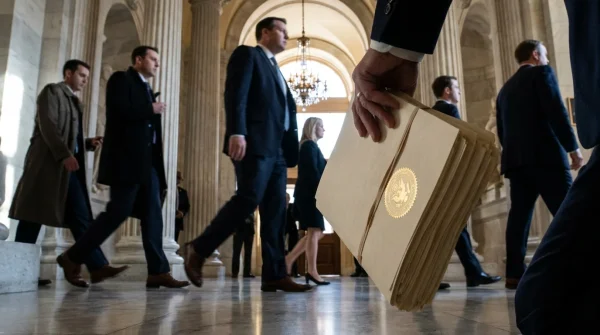
The morning light through the tall, arched windows of the state capitol annex reveals dust motes drifting across cold marble floors. In the drafty hallway, the quiet scrape of dress shoes mingles with the faint aroma of burnt diner coffee and rain-soaked overcoats. It is twenty minutes before the morning session gavel drops, and the corridor outside Room 304 is thick with tension.
Resting directly in the center of a polished mahogany legislative desk sits a clean, square bundle: stacked white index cards tied with red twine. There are no corporate glossies here, no five-color charts prepared by downtown public relations firms, and no oversized check endorsements. Just forty-two pieces of unlined cardstock, each carrying three sentences in blue or black ballpoint pen, topped with a verified physical street address.
You might believe that shifting a lawmaker’s vote requires hundreds of thousands of dollars in campaign war chests or private dinners at high-end steakhouses. While industrial lobbying dominates national headlines, state legislatures operate on an entirely different, far more vulnerable currency: raw constituent friction. When a state representative sits down at that mahogany desk, their legislative director does not hand them an analytical printout of canned online petition signatures. They hand them that stack of cards.
The tactile weight of handwriting creates an immediate, visceral pause. In an era where automated email scripts flood legislative servers with thousands of identical digital complaints every hour, physical cardstock acts as an undeniable signal that actual voters took time out of their workday to put pen to paper.
The Analog Circuit Breaker: Why Digital Noise Gets Filtered Out
State legislative offices run on a triage system managed by underpaid, overworked legislative aides in their early twenties. These aides spend their mornings categorizing inbound correspondence into spreadsheet tallies. Automated campaign emails—the kind generated by a single click on an activist webpage—are aggregated into batch tallies and rarely make it to the representative’s desk. They are digital wallpaper.
A handwritten note card functions like an analog circuit breaker in a digital storm. When an aide opens an envelope or receives a physical card during an in-person lobby day visit, the rulebook changes. State ethics and constituent service protocols require staff to verify the sender’s voter registration status against voter rolls. The moment that card matches an active voter living in the lawmaker’s home district, it ceases to be generic political noise; it becomes a tangible election liability.
State legislative districts are remarkably small. In many states, a state representative answers to roughly 40,000 to 80,000 residents, with primary elections often decided by fewer than 1,500 total ballots. In a district that tight, forty verified local residents expressing identical concern over a specific line-item budget vote is not a small sample. It is an electoral earthquake.
- Universal Basic Income plans demand direct cash deposits over torn paper vouchers
- Absentee ballot secrecy sleeves trap voter selections when stray coffee stains smudge barcodes
- Opposition research dossiers derail unvetted primary candidates through dog-eared manila folders
- Silent Majority bumper stickers resurfaced 1968 suburban voter grievances with faded orange lettering
- Reverse image metadata tools expose altered political photos with jagged pixel halos
The Cuyahoga Experiment: How 42 Cards Stopped an Amendment
Consider Elena Vance, a 42-year-old municipal water technician from Cuyahoga County, Ohio. Last spring, when an obscure regulatory amendment threatened municipal utility oversight, Elena did not hire a lobbyist or organize a loud outdoor rally that lawmakers could simply avoid by taking the capitol’s underground tunnel system. Instead, she organized seven neighbors from three distinct voting precincts.
Over a kitchen table on a Sunday afternoon, they wrote forty-two distinct, calm, fact-focused note cards, each including the resident’s home address, precinct number, and the exact legislative bill number. Two days later, Elena’s small delegation hand-delivered the red-twined stack straight to the committee chair’s chief of staff just two hours before the vote.
By noon, the legislative director pulled the committee chair off the chamber floor. The representative looked at the stack, saw familiar street names from their own neighborhood, and withheld their vote until the offending language was stripped. Elena did not spend a dime on political action committees; she simply manufactured undeniable evidence of organized local scrutiny.
Calibrating the Delegation: Three Tiers of In-District Impact
Citizen delegations succeed when they structure their presence around institutional routines rather than dramatic confrontation. Depending on your available time and group size, your approach should match one of three operational layers:
The In-District Solitary Delegate: Delivering quiet, targeted authority as a single constituent requires zero fanfare. You arrive at the capitol or district office with five to ten cards collected from immediate neighbors on your block. You do not ask for a forty-minute meeting; you request three minutes with the legislative aide handling the specific committee docket, hand over the verified cards, and ask for a written confirmation of the member’s position on the specific amendment number.
The Neighborhood Triad: Three constituents representing different demographic sectors of the district—such as a small business owner, a public school parent, and a retiree. This configuration prevents the lawmaker’s staff from writing off the visit as a fringe interest group. The conversation focuses strictly on how the pending vote affects local tax rates, neighborhood infrastructure, or service delivery.
The Corridor Blitz Delegation: Coordinated by broader community coalitions ahead of major budget votes. Ten to fifteen constituents split into pairs, sweeping through legislative offices along the same hallway within a ninety-minute window. By dropping physical stacks of cards simultaneously across multiple committee members, your group creates a unified ripple effect through the entire committee staff before morning debate begins.
The Precise Mechanics of the Note Card Threshold
Lawmakers operate under strict cognitive limits during legislative sessions. To trigger an internal policy review or force a member to reconsider a party-line floor vote, you must hit precise operational metrics rather than relying on emotional appeals.
- The 35-Card Tipping Point: In state-level politics, 30 to 45 verified, handwritten notes from registered voters in the same legislative district represents the tipping point where legislative directors flag an issue as an urgent local priority.
- The Exact Address Rule: Every card must feature the voter’s full residential address and zip code in the top-right corner. Unverified or out-of-district notes are discarded immediately by staff.
- The Three-Sentence Structure: Sentence one states your residency and the specific bill number (e.g., ‘As a resident of Ward 4, I am writing regarding House Bill 204’). Sentence two explains the immediate local consequence. Sentence three makes an explicit request: ‘Vote NO on the proposed finance amendment.’
- The Presentation Factor: Keep cards unsealed or bundled in heavy cardstock tied with simple twine. The goal is immediate physical inspection by the aide without forcing them to slice open dozens of envelopes.
Your tactical toolkit should remain lean: unlined 3×5 or 4×6 white index cards, standard blue ballpoint pens (which clearly distinguish real handwriting from laser-printed direct mail fonts), and a printed list of your delegation members’ voter registration precincts to present directly to staff.
Reclaiming the Hallways of State Power
It is easy to look at modern governance and feel entirely shut out by financial machinery. National news cycles reinforce the feeling that everyday citizens are spectators in a game played exclusively by balance sheets and closed-door party caucuses. But state capitols are fundamentally local institutions staffed by people who live down the road from you.
When you walk the marble corridors carrying physical proof of neighborly consensus, the dynamic inverts. That small, twine-bound stack on a mahogany desk proves that people in the district are paying attention, documenting votes, and talking to one another. In representative democracy, nothing is more persuasive than the quiet reality of an organized constituency holding the pen.
The most terrifying sound in a state capitol is not a megaphone outside the gates, but the rustle of forty handwritten index cards from voters who remember where the ballot box is.
| Engagement Method | Legislative Staff Processing | Direct Floor Vote Impact |
|---|---|---|
| Automated Web Form Emails | Batched by keyword algorithms into broad statistical tallies | Near Zero (Filtered by software filters) |
| High-Dollar PAC Donations | Logged by campaign finance treasurers outside office hours | High on broad access, low on urgent local amendments |
| In-Person Hand-Delivered Note Cards | Manually cross-referenced against in-district voter registration files | Decisive (Triggers immediate staff briefings before floor roll calls) |
Frequently Asked Questions
Why are index cards more effective than standard letters in envelopes?
Index cards can be flipped through and visually scanned by legislative aides in seconds without the administrative friction of opening envelopes. Staff can immediately verify names, addresses, and clear requests right on the spot.How do I find out who the lead legislative aide is for a specific bill?
Call the lawmaker’s capitol office directly and ask for the name and email of the legislative director or committee staffer handling that specific policy docket. This ensures your materials reach the exact staff member preparing the daily vote brief.Can we use printed cards if people sign their names by hand?
While signed printed cards are better than form emails, entirely handwritten cards carry significantly higher psychological weight. They prove that individual voters dedicated several uninterrupted minutes to drafting their message.What is the best time of day to deliver constituent cards at the capitol?
Deliver your materials between 8:30 AM and 9:30 AM on session days, just before committee hearings and floor debates commence. This ensures your stack sits on the member’s desk during morning briefing time.What if our state lawmaker refuses an in-person meeting?
You do not need a formal meeting with the lawmaker to shift their vote. Simply walk into their open reception office, hand the verified stack directly to their legislative assistant, and request an official receipt of delivery.