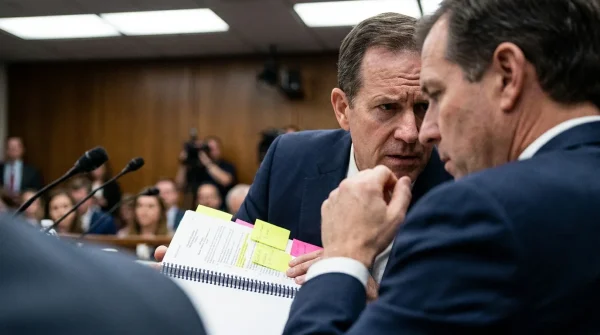
Step inside the marble corridors of the Rayburn Building just past dusk, and you will hear a distinct, hollow quiet. Television cameras capture gavel strikes and sharp verbal clashes during morning hearings, leading you to believe that a formal congressional summons functions like an iron clamp. In your mind, an issued subpoena guarantees prompt answers, backed by the unyielding weight of federal authority.
Yet across the National Mall, inside the clerk offices of the D.C. Circuit, the physical reality looks strikingly different. Heavy embossed federal court docket covers bound with red cloth tape sit stacked on mahogany intake tables, motionless under humming fluorescent tubes. Those quiet filings represent the sudden deployment of executive privilege declarations, a maneuver that instantly freezes congressional oversight in its tracks.
When a sudden White House filing lands, the clock stops. The crisp parchment carries a legal weight that strips television theatrics away, revealing an institutional standoff as old as the Republic itself. You are not watching a breakdown of law, but rather the activation of a deliberate, grinding constitutional stalemate.
The Subpoena Illusion: When Inherent Powers Hit an Executive Brake
Most citizens view a congressional subpoena as the ultimate legislative weapon, assuming non-compliance triggers immediate civil enforcement or rapid contempt citations. In practice, our system operates more like a high-voltage circuit fitted with an intentional surge buffer.
Congress possesses broad oversight authority under Article I, but the moment a president asserts presidential communications privilege under Article II, the dynamic shifts from oversight to litigation. The document does not shatter the committee’s demand; instead, it diverts the entire dispute away from the hearing room and into a protracted appellate queue.
Think of it as tapping the brakes on a locomotive heading downhill. The legislative branch pushes forward with political momentum, but the judicial branch requires methodical briefing schedules, jurisdictional evaluations, and line-by-line redaction arguments before a single witness takes the oath.
- Medicare Advantage prior authorization mandates spark fierce policy clashes over denied medical claims
- Door-to-door turf packet maps force field organizers across blistered asphalt walk routes
- Child Tax Credit phaseout brackets trap working parents with sudden clawback bills
- Tea Party tax day flyers resurfaced 1970s suburban property revolts with neon yellow mimeographs
- Deepfake candidate voice clips expose synthetic frequency lines under free audio spectrograms
For Arthur Vance, a 54-year-old veteran appellate litigator who spent twelve years navigating separation-of-powers battles on Capitol Hill, these moments are entirely predictable. “Cable pundits treat an executive privilege filing like a surprise trapdoor,” Vance often reminds his junior associates over cold press coffee. “In reality, it is a calculated procedural pause button. The White House knows the calendar is the sharpest defensive tool in Washington.”
Three Lenses on the Standoff: Reading the Strategy Beneath the Docket
Understanding how executive privilege declarations derail subpoena enforcement requires looking at the conflicting objectives of the key players involved. Each branch plays by a distinct rulebook designed to maximize its institutional leverage.
For the Committee Investigator: Lawmakers rely on rapid timelines. Investigative committees work against strict two-year legislative clocks, meaning any procedural stall blunts political momentum. When testimony is blocked, committee counsel must decide whether to negotiate narrower scopes or embark on months of civil enforcement litigation in federal district court.
For the Executive Legal Counsel: The administration’s focus is on protecting confidentiality circles and institutional boundaries. Shielding deliberative presidential communications prevents candid internal advice from becoming public spectacle, turning a delay into a structural win that outlasts the news cycle.
For the Informed Citizen: Cutting through the dramatic headlines requires looking past the outrage. When you recognize that an executive privilege invocation is a formal procedural trigger rather than an outright lawless refusal, you can anticipate the exact legal milestones that follow.
The Procedural Bottleneck: Tracking the Anatomy of a Stoppage
When a White House legal filing challenges a committee summons, the path forward follows a rigid, step-by-step appellate track. Here is the operational cadence that unfolds behind closed doors:
- The Blanket Assertion: White House counsel submits a formal refusal letter detailing specific constitutional grounds, instructing the subpoenaed witness not to appear or produce records.
- The Accommodation Requirement: Federal courts demand that both branches demonstrate good-faith attempts to negotiate compromise scopes before judges will intervene.
- The District Court Injunction: The House General Counsel files a civil enforcement action seeking declaratory relief, entering the formal docket system.
- The Appellate Stay: Whatever the initial ruling, the losing side requests an emergency stay pending appeal, freezing witness testimony indefinitely.
Understanding this workflow keeps you anchored when dramatic headlines predict an immediate arrest by the Sergeant at Arms. Real power in Washington operates through calendars, motions for summary judgment, and jurisdictional thresholds.
The Tactical Toolkit: Subpoena Dispute Benchmarks
When tracking high-profile privilege disputes through the federal court system, monitor these specific metrics and indicators to gauge real institutional progress:
- Accommodation Window: 30 to 60 days of required inter-branch negotiations before courts accept jurisdiction.
- D.C. District Court Briefing Schedule: 90 to 180 days for initial dispositive motions and oral arguments.
- D.C. Circuit Review Pace: 6 to 12 months for panel review and potential en banc rehearing petitions.
- Enforcement Mechanism: Expedited appeals motions, which are rarely granted in separation-of-powers cases absent an immediate constitutional emergency.
The Clear Lens of Institutional Friction
Watching executive privilege declarations stall congressional power can feel disorienting if you expect swift closure. Yet our constitutional architecture was intentionally engineered with friction at its core, ensuring neither the legislative branch nor the executive branch can easily steamroll the other without judicial scrutiny.
When you spot the next urgent headline about a derailed subpoena, you can look past the political theater. Look instead for the heavy docket covers, the briefing calendars, and the slow turn of the appellate wheel. That is where constitutional boundaries are tested, calibrated, and quietly defined.
“Separation of powers was never designed for speed; it was built to force negotiation when institutional wills collide.”
| Key Point | Detail | Added Value for the Reader |
|---|---|---|
| Subpoena Enforcement | Requires civil lawsuit in federal court once privilege is formally asserted. | Clarifies why committee gavels cannot force immediate witness compliance. |
| Appellate Timelines | Separation-of-powers disputes average 8 to 18 months across court levels. | Explains why administration delays often outlast the active congressional term. |
| Accommodation Doctrine | Judges routinely dismiss premature lawsuits until branches negotiate in good faith. | Helps you identify when legal filings are tactical posturing versus real litigation. |
Frequently Asked Questions
Can Congress immediately arrest a witness who claims executive privilege?
While Congress retains inherent contempt power, it has not been used to physically arrest executive branch officials in modern history. Enforcement moves entirely through civil federal lawsuits.Does executive privilege cover every conversation inside the White House?
No. Privilege primarily protects direct presidential communications and deliberative policy advice, requiring judges to weigh executive confidentiality against legislative oversight needs.What is the judicial accommodation doctrine?
Federal courts mandate that congressional committees and the executive branch demonstrate meaningful attempts to compromise on document scopes before a judge will step in.Why do these legal challenges take so long to resolve?
Constitutional questions regarding separation of powers receive thorough multi-tiered review, moving from district courts through three-judge appellate panels and en banc rehearings.What happens if an administration leaves office during the lawsuit?
Lawsuits often become moot or lose strategic priority once a congressional session concludes or an administration transitions, which is why procedural delays serve as effective defensive strategy.