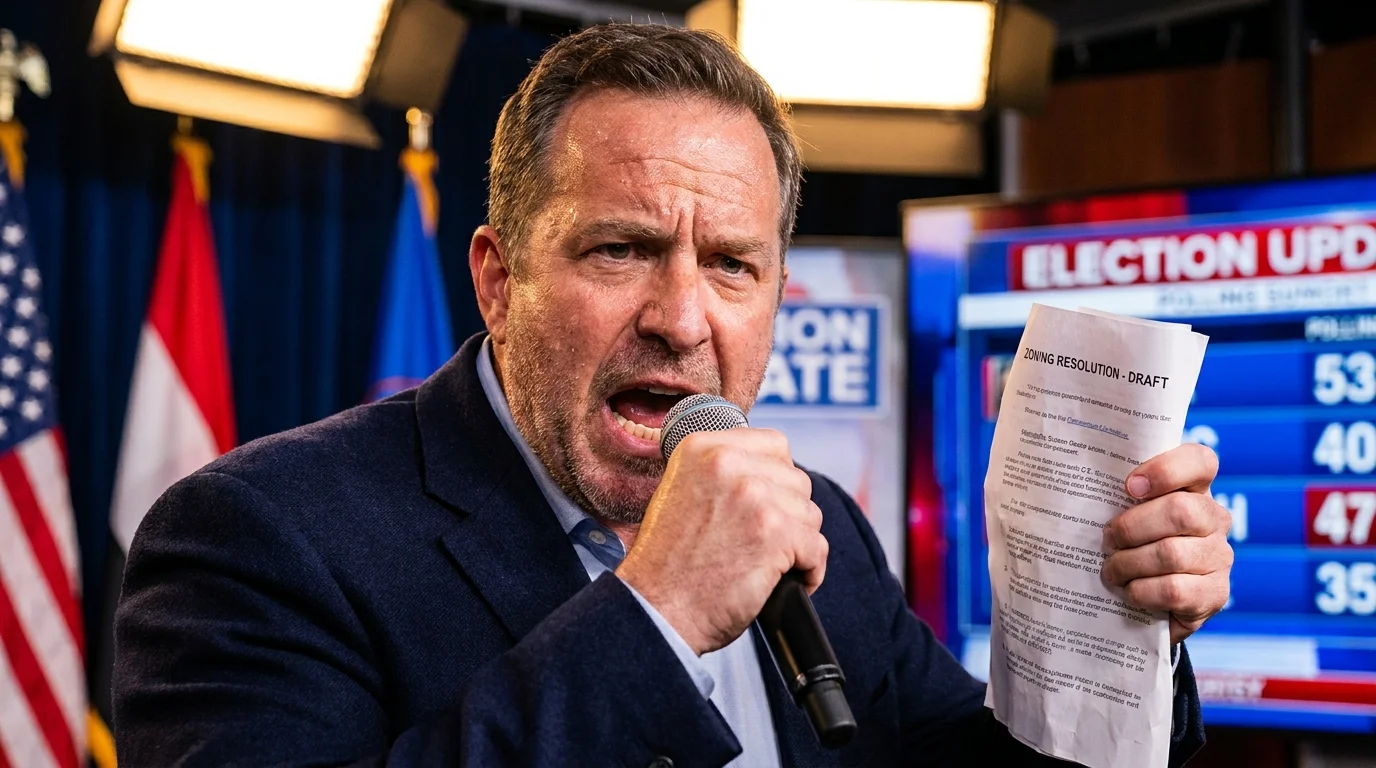
You can smell the damp wool coats and stale convenience-store coffee the moment you push through the double doors of the township municipal building. Outside, the November frost is already silvering the lawns along Route 332, but inside, the air is thick, hot, and humming with the low vibration of a hundred conversations competing for space. The plastic folding chairs scraped against linoleum twenty minutes ago, and now the room is standing-room-only, bodies pressed against wood-paneled walls beneath buzzing fluorescent tubes.
You might expect this room to divide cleanly along the lines painted by cable news, with blue yard signs on one side and red on the other. Instead, lifelong party loyalists are sitting shoulder-to-shoulder, comparing handwritten notes on municipal land-use amendments. The anger here does not care about national platforms; it focuses entirely on parcel maps, stormwater runoff models, and sudden changes to municipal density codes that threaten to redraw neighborhood boundaries. In these crowded township rooms, hyper-local battles have rewritten the rules of suburban political survival.
For decades, political strategists treated Pennsylvania’s bellwether suburbs like an automated switchboard. You turned out the party faithful in Lower Makefield, ran voter registration drives in Bensalem, and relied on predictable suburban voting patterns to deliver statewide margins. That machine is breaking down against the reality of township meeting agendas, leaving organizers from both major parties scrambling to understand an electorate that has suddenly abandoned standard party loyalties.
The Backyard Battleground: Why Concrete Trumps Ideology
To understand what is unfolding across Bucks County housing debates, you have to discard the myth that suburban voters see their communities through a partisan prism. For most homeowners, your property deed is not an ideological statement; it is your family savings account, your retirement hedge, and your children’s school district access wrapped into a single physical plot of dirt. When local supervisors introduce sweeping residential zoning shifts or allow multi-family developments on preserved green space, that anchor feels instantly threatened.
Think of it as the difference between watching weather reports on television and watching water seep into your basement. National political debates are the television broadcast, abstract and distant, while local land decisions represent water pooling on the floorboards. When the municipal sewer authority announces an unvetted capacity expansion or a developer files an eleventh-hour conditional-use petition, the national debate fades. What remains is a fierce, single-issue focus on preserving the community landscape you paid to join.
This shift has caught campaign consultants off guard because it defies demographic forecasting models. When a township board votes to clear five acres of historic farmland for high-density cluster townhomes, the resulting neighborhood revolt crosses every demographic line. Homeowners do not consult party headquarters before organizing petition drives; they gather around kitchen tables to fund land-use attorneys, entirely indifferent to which party holds the supervisor gavel.
- Donald Trump audio leak hoax triggers national outrage after foreign server traces
- Maurene Comey DOJ lawsuit leaks spark West Wing panic over sudden retaliation claims
- Sackett wetland property rulings freeze municipal public works contracts across county development boards
- Citigroup municipal bond bans trigger swift state legislative retaliation over controversial corporate policies
- Department of Justice reassignments dismantle senior career civil service protections across federal litigation desks
The Analyst in the Room
Consider Elena Rostova, 48, an independent municipal bond analyst and lifelong resident of Newtown Township. For two decades, she voted in every primary election like clockwork, reliably backing the county-endorsed slate. Last spring, when her township supervisors quietly pushed through an expedited variance permitting a commercial logistics hub adjacent to a 140-home development, she bypassed her local party committee entirely.
Instead, Rostova spent three weeks combing through municipal balance sheets and sewer infrastructure grants, discovering that taxpayers were underwriting the utility extensions for private builders. She organized a nonpartisan coalition of six hundred neighbors that forced the supervisors into a public rescission vote within forty-five days. “Once you see how local land deals actually pass,” Rostova says, “you realize the ballot line on top of the ticket is completely irrelevant to who paves your street or crowds your elementary school.”
The Fractured Coalition: Mapping the Suburban Rebellion
This localized discontent does not form a single homogeneous voting block. Instead, it creates distinct, high-intensity voter segments that campaign consultants cannot reach through standard television buys or automated party mailers.
Understanding where you sit in this landscape clarifies why traditional campaigns feel disconnected from your day-to-day community concerns.
- The Legacy Freeholders: Homeowners who purchased their properties fifteen to thirty years ago under strict single-family covenants. Their primary focus is municipal infrastructure preservation, maintaining historic district boundaries, and preventing unfunded public school capital expansions that drive double-digit school tax increases.
- The Relocation Transplants: Families who moved into upper Bucks County within the last five years, paying historically high mortgage rates to secure half-acre yards and quieter streetscapes. They are hyper-attentive to zoning variances and view unexpected density shifts as an immediate breach of contract by local government.
- The Priced-Out Generations: Young adults and service workers raised in these exact communities who find median home sales prices exceeding regional wages. While traditional developers claim high-density projects solve affordability, these residents find that new luxury rentals offer no real path to long-term ownership, leaving them equally alienated by both parties’ proposals.
These groups disagree on density solutions, but they share deep skepticism toward party-line assurances. When election day arrives, homeowners vote on zoning records rather than national rhetoric, creating sudden precinct-level swings that leave seasoned political directors bewildered.
How to Track Your Local Land-Use Pipeline
Protecting your household from sudden municipal surprises requires active, quiet vigilance rather than waiting for election-year campaigns to sound alarms. Land-use shifts rarely happen overnight; they travel through months of procedural filings before heavy machinery appears at your street corner.
You can monitor your community’s regulatory trajectory by taking a few deliberate, structured steps every month.
- Review Planning Commission Dockets: Check your township website every first and third Monday for Planning Commission agendas. Development plans and zoning variances must appear here weeks before reaching elected supervisors for final consideration.
- Examine Conditional-Use Applications: Identify whether incoming residential projects request waivers from standard density caps or setback rules. These filings detail precisely how developers intend to bypass baseline municipal requirements.
- Track School Board Capacity Audits: Attend or read minutes from school board facilities committees. Sudden shifts in residential permitting surface first in student demographic projections and bus route redistricting discussions.
- Inspect County GIS Parcel Maps: Utilize the Bucks County Board of Assessment public mapping portal to check ownership changes and tax assessment status on open parcels abutting your neighborhood before preliminary subdivision plans are submitted.
Maintaining this habit takes twenty minutes twice a month, but it transforms you from a surprised resident reacting to construction equipment into an informed citizen capable of intervening during statutory public comment windows.
The Tactical Toolkit: Critical Municipal Timelines
When township boards evaluate contentious development plans, Pennsylvania state law imposes strict regulatory deadlines that work to your advantage if you know how to track them.
- Sunshine Act Public Notice Window: Official agency meetings and agenda additions must be publicly posted at least 24 hours prior to municipal deliberation, offering your last opportunity to review draft resolutions before a formal vote.
- Zoning Hearing Board Appeal Clock: In Pennsylvania, aggrieved neighbors have precisely 30 days from the issuance of a zoning permit or variance approval to file a formal appeal before the decision becomes legally irrevocable.
- Act 247 Municipal Planning Timelines: Supervisors have 90 days from the date of an official land development application to render a formal decision; failure to act within this statutory window can result in a “deemed approval” for the developer by default.
The Dissolution of the Red-Blue Metric
When you walk out of a packed township meeting into the crisp suburban night, the national political map feels like an abstraction drawn by people who have never stepped foot on your street. The easy division of the electorate into two monolithic tribes dissolves when the conversation turns to school boundary lines, water tables, and property assessments.
Mastering the intricacies of hyper-local land use restores your voice in a political system that often prefers you passive, angry, and predictable. By anchoring your political participation to the actual dirt beneath your feet, you regain genuine political leverage that no national party committee can easily take away.
Real political autonomy begins the moment you realize your township zoning officer has a greater daily impact on your household wealth than your member of Congress.
| Key Point | Detail | Added Value for the Reader |
|---|---|---|
| Partisan Realignment | Suburban voters prioritize property stability over traditional party affiliation. | Reveals why standard campaign party appeals fail to predict actual neighborhood voting behavior. |
| Statutory Deadlines | Pennsylvania Act 247 mandates a strict 30-day appeal limit on zoning variances. | Prevents you from missing legal objection windows that permanently lock in local developments. |
| Infrastructure Costs | High-density approvals often transfer utility expansion burdens to current local taxpayers. | Helps you identify hidden sewer and road maintenance surcharges embedded in local property assessments. |
Frequently Asked Questions
How do housing battles in Bucks County directly impact the 2026 midterm elections?
Because Bucks County is one of the premier swing counties in Pennsylvania, small precinct shifts driven by hyper-local zoning disputes can flip state legislative seats, congressional races, and statewide margins regardless of national political trends.Why are suburban homeowners abandoning party loyalty over local zoning?
Home equity, neighborhood density, and school redistricting represent direct, tangible impacts on a family’s financial future, making local land decisions far more immediate and motivating than national party platforms.Where can I find early warning signs of rezoning in my township?
Examine the preliminary agendas of your township’s Planning Commission and Zoning Hearing Board, which publish variance requests and conditional-use applications weeks before supervisors hold a public vote.What is a deemed approval, and why should residents monitor it?
Under Pennsylvania law, if a municipal board fails to act on a completed land development application within 90 days, the plan can be legally approved by default, bypassing public input entirely.Can township supervisors change zoning without homeowner consent?
Yes, supervisors hold statutory legislative authority to amend local zoning ordinances, though they must hold an advertised public hearing and give residents an opportunity to comment before passing any amendment.