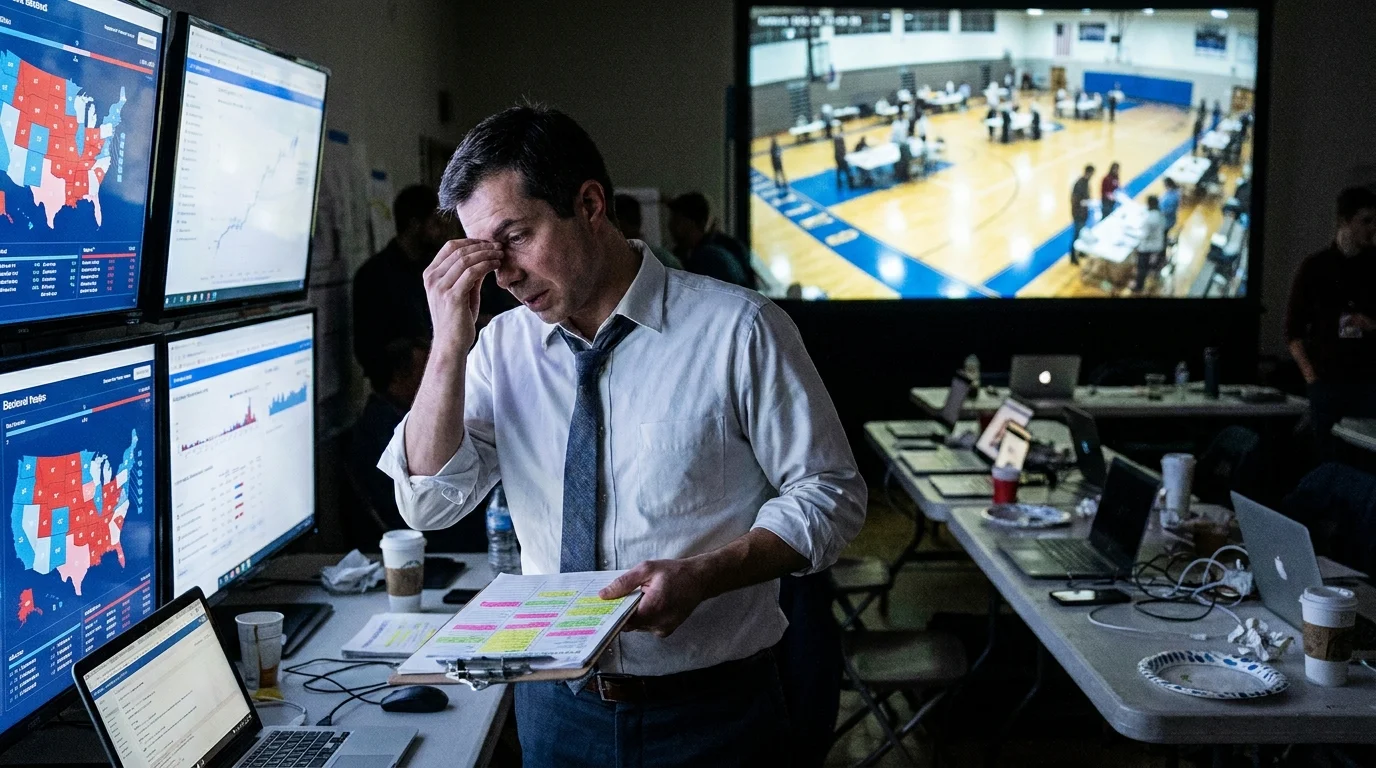
The damp bite of a sub-zero evening clings to heavy parkas draped over metal folding chairs. Under the hum of high-bay fluorescent tubes, the unmistakable aroma of wet wool, instant decaf, and floor wax settles across the room. Beneath your boots, the squeaky varnished gymnasium floor marked with blue painter tape maps out competing territories along the three-point arc.
You arrived expecting the quiet solemnity of the American franchise: a curtained booth, a felt-tip pen, and a private slip dropped into a padlocked box. Instead, you step directly onto an open stage where civic conviction is calculated not in private tallies, but in physical human mass standing publicly under the glare of your neighbors.
By seven-fifteen, the exterior doors latch shut. The draft seeps along the baseboards as coats stay zipped and breath hovers faintly in the unheated corners of the municipal hall. What feels like an unruly neighborhood gathering is actually a highly calibrated machine running on psychological pressure, stamina, and spatial geometry.
The Mirage of the Secret Ballot: Democracy as a Living Chessboard
The standard primary lets you vote in solitary peace and walk away clean. The precinct caucus strips away that privacy entirely, treating your body as a visible counter on a civic grid. When your candidate of choice is assigned to the bleachers near the emergency exit, your physical relocation announces your worldview to your kids’ middle school teachers, your dry cleaner, and your next-door neighbor.
This public sorting turns neighborly courtesy into raw leverage during high-stakes realignments. When the initial headcount begins, staying put requires enduring deliberate eye contact across the free-throw line. The system operates on a fundamental truth of human behavior: most people will soften their convictions simply to avoid being isolated in the center circle.
Take Sarah Lindqvist, 42, who has served as a precinct secretary in Polk County across four election cycles. She keeps a roll of masking tape and a mechanical tally counter in her pocket, watching the room divide into islands of certainty and hesitation. Her quiet observation over decades of winter meetings is simple: races are rarely won by the slickest speeches from the bleachers, but by the precinct workers who know how to corner an exhausted family shivering near the water fountain before the viability clock runs out.
- Federalist Society debates resurfaced forgotten nineteenth century judicial oaths using dusty leatherbound transcripts
- Zoning maps dictate modern housing shortages based on outdated redlining
- Mail-in ballots cause unexpected postal delays across crucial swing counties
- Tariff schedules trigger immediate supply chain panics ahead of expected legislation
- PAC television ads dominate local screens by exploiting federal broadcasting loopholes
The Three Layers of Gym-Floor Influence
Every caucus floor spontaneously organizes itself into distinct behavioral tiers. Understanding where you sit—or stand—determines whether you are directing the room or being managed by it.
For the Committed Anchor
These are the precinct stalwarts who arrive forty minutes early to claim the perimeter bleachers. They plant themselves against the radiator walls, using heavy winter coats to physically claim square footage for their candidate. Their strategy is pure territorial defense: anchoring a visibly viable cluster so early arrivals instantly perceive momentum without exchanging a word.
For the Drifting Undecided
Hovering between the key and the half-court line, this group is visibly uncommitted, clutching informational flyers like protective shields. Because they lack a physical group to anchor them, they bear the full brunt of social pressure. To the trained precinct strategist, an unaligned voter checking their watch near the exit is an open target for immediate conversion.
For the Tactical Organizer
Equipped with color-coded clipboards and digital headcount spreadsheets, these operators rarely sit down. They pace the boundary lines marked with blue tape, calculating viable thresholds to the exact decimal point. Their job is not inspiration; it is logistical extraction, sweeping unviable candidate groups into their fold before the thirty-minute realignment window shuts.
The Clipboard Playbook: Deconstructing the Realignment Gauntlet
Once the initial tally concludes, any candidate group failing to secure fifteen percent of the room is declared non-viable. Their supporters must disband, pick another viable candidate, or walk out into the freezing night. This thirty-minute window is where the unwritten rules of campaign logic take over.
- The Triage Assessment: Campaign captains cross-reference color-coded spreadsheets, ignoring deeply entrenched rivals to swarm groups that fell just short of the viability line by two or three bodies.
- The Proximity Squeeze: Organizers do not yell across the court; they step into your personal orbit, speaking at conversational volume while physically guiding you toward their designated zone with open-palm gestures.
- The Clock Deprivation: Precinct chairs call out time remaining at five-minute intervals, using the psychological weight of an advancing deadline to push undecided voters into line simply to end the meeting.
- The Neighborly Appeal: Captains dispatch trusted community figures—a local volunteer fire chief or familiar youth coach—to make the final soft pitch to lingering holdouts.
Surviving this gauntlet without compromising your intent requires recognizing that the physical discomfort of the room is part of the operational filter. Standing on bare wood for three hours in winter gear wears down civic resolve faster than any televised debate ever could.
The Enduring Tension of Public Alignment
As national parties continue to debate primary calendar reshuffling and demand streamlined digital voting, the open-floor caucus remains an unsettling relic of direct democracy. It forces citizens to trade the safety of anonymity for the accountability of physical presence.
There is a stark, uncomfortable honesty in having to stand up for your choices in front of the people you pass at the grocery store every Tuesday morning. When you finally step out of the gymnasium into the clean, freezing night air, the silence of the parking lot feels earned. You did not just cast a preference; you visibly owned your civic ground in an arena built for public scrutiny.
The physical caucus floor transforms political belief from a private opinion into an act of public witness where every step across the hardwood carries social weight.
| Key Point | Detail | Added Value for the Reader |
|---|---|---|
| Physical Sorting Mechanism | Voters cluster into visible geographic zones inside the room rather than using private paper ballots. | Reveals why community standing directly impacts voting independence on caucus night. |
| The 15% Viability Rule | Candidate clusters failing to reach the fifteen-percent threshold are dissolved and forced to realign. | Clarifies the mathematical trigger that initiates high-pressure campaign recruitment windows. |
| Clipboard Realignment Tactics | Precinct captains deploy color-coded tracking sheets to aggressively lobby unviable voting groups. | Provides mental clarity to recognize and resist engineered social pressure techniques. |
Frequently Asked Questions
Can I leave the gymnasium before the final viability headcount is completed?
You can technically leave at any point, but exiting before your group is formally recorded means your presence will not count toward the precinct delegate allocations.Why do caucuses continue to use standing counts instead of paper slips?
Open counts maintain historical party traditions of public assembly and allow immediate real-time reallocation of non-viable groups without printing thousands of tiered ballots.What happens if a candidate group falls short of viability by just one person?
Campaign captains have a strictly timed window to convince a single unaligned or non-viable voter to cross the floor and join their cluster before the chair locks the count.Are precinct captains legally allowed to block people from switching groups?
No, campaign volunteers cannot physically restrict movement, though they routinely use spatial crowding and intense verbal persuasion to retain their supporters.How has the national primary calendar reshuffle affected these traditional events?
Reforms have placed heavy scrutiny on caucus access barriers, pushing state parties to adopt streamlined reporting systems while debating the long-term role of physical gatherings.