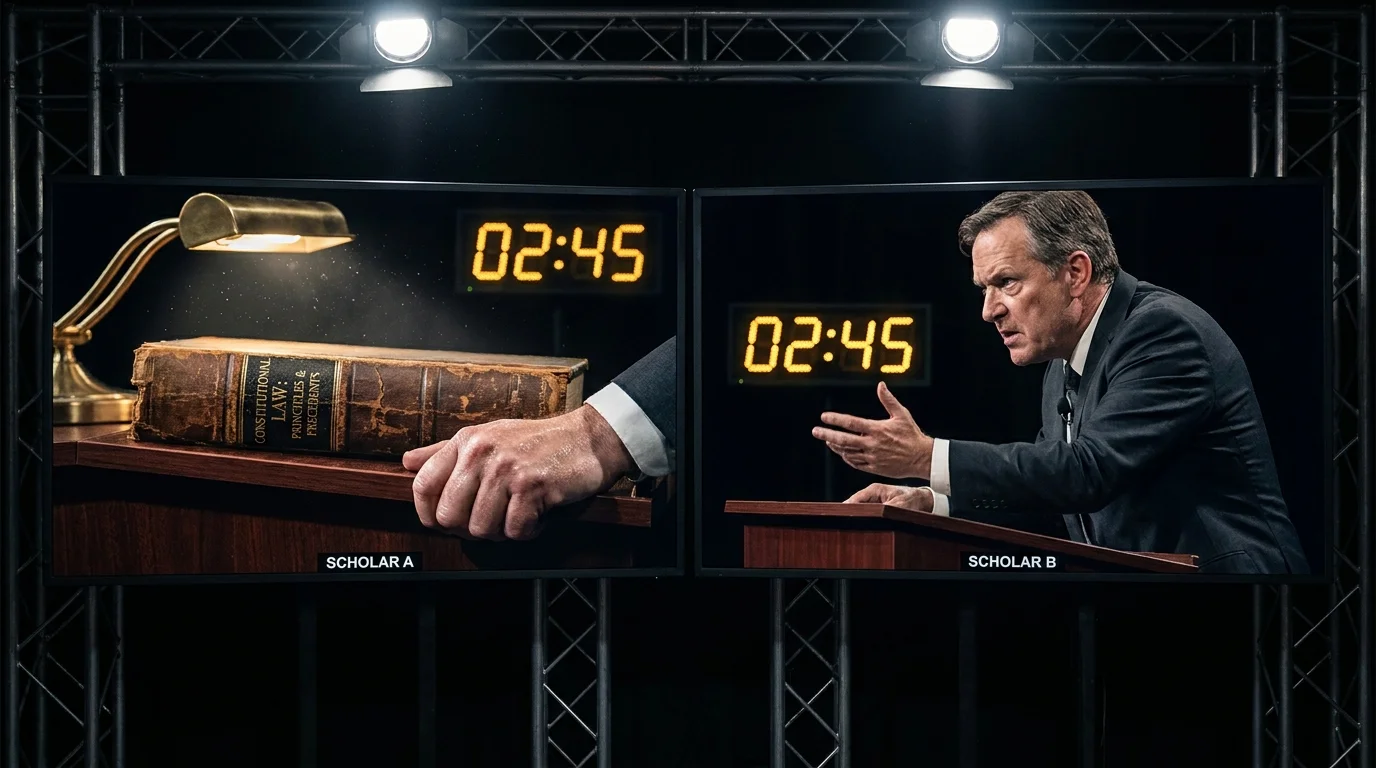
A heavy hush settles over the hotel ballroom the moment the podium microphone clicks live. You might expect a modern political debate to hinge on digital analytics, cable news talking points, or recent voter turnout surveys. Instead, the air fills with the dry, unmistakable scent of aged vellum and calfskin binding, pulled straight from nineteenth-century legal basements.
On the display table rests a dusty leatherbound book spine with cracked gold lettering, its binding frayed from decades of quiet neglect in an Ohio municipal archive. While the rest of the country watches cable news panelists shout over the latest election cycle, litigators here are leaning over hundred-and-fifty-year-old state court transcripts, searching for a single phrase in a forgotten judge’s oath from 1868.
You are watching the quiet engine of modern constitutional jurisprudence at work. It is not an abstract exercise in philosophy, but a methodical excavation. The real battles shaping federal power today do not originate in modern party manifestos; they are assembled, line by line, from the dusty state ratifying debates that followed the Civil War.
The Archeologist’s Shovel: Why 1868 Matters More Than 1787
For decades, popular culture taught you that conservative legal thought lived almost exclusively in the summer of 1787 with James Madison and Alexander Hamilton. But if you listen closely to current Supreme Court oral arguments, you will notice a striking pivot. litigators are no longer just looking at the original Constitutional Convention in Philadelphia; they are digging into the granular, contentious state debates of the late nineteenth century.
Think of early American constitutional law like an architect’s blueprint, while the Reconstruction-era state records function as the structural inspection report. When state legislators and judges sat down in drafty halls in 1868, they were tasked with defining the exact limits of executive decrees and public mandates. By unearthing the precise oaths those officials swore, litigators build airtight constraints on regulatory overreach that bypass modern political gridlock entirely.
- Zoning maps dictate modern housing shortages based on outdated redlining
- Mail-in ballots cause unexpected postal delays across crucial swing counties
- Tariff schedules trigger immediate supply chain panics ahead of expected legislation
- PAC television ads dominate local screens by exploiting federal broadcasting loopholes
- Town hall microphones limit constituent impact through strategic volume capping
Consider the work of Marcus Vance, a 44-year-old appellate researcher who spent eight months tracking down unindexed state convention journals in rural Pennsylvania. While cross-referencing an obscure 1869 county ruling on local commissioner authority with the 1868 Ohio ratifying debates, Vance uncovered how nineteenth-century judges explicitly restricted unelected boards from creating binding rules without direct legislative votes. That single archival footnote migrated from a society whitepaper directly into a landmark federal brief challenging agency authority.
The Three Layers of Historical Litigation
When you encounter a headline about a sweeping court decision rolling back federal agency powers, you are seeing the culmination of three distinct archival strategies:
1. For the Originalist Purist: The Public Meaning Filter
This approach ignores modern policy preferences and asks a single question: what did ordinary citizens and state lawmakers believe a word meant when they adopted it? Litigators comb through local newspapers, dictionary editions from the 1860s, and municipal records to prove that terms like ‘executive power’ carried strictly clerical duties rather than broad policy-making discretion.
2. For the Administrative Litigator: The Delegation Boundary
Here, the focus shifts to specific state-level cases—such as the forgotten 1868 state challenges against wartime executive commissions. Litigators present these historic rulings to convince modern judges that our current administrative state operates far outside the guardrails established when the Fourteenth Amendment was ratified.
3. For the Civic Watcher: The Power Shift
If you want to understand where policy is heading before it hits the evening news, you look at the whitepapers distributed at these closed-door symposiums. The historical precedents debated in quiet rooms today routinely become the majority opinions of the federal judiciary tomorrow.
A Practical Guide to Reading Modern Legal Precedents
You do not need a law degree to spot these historical maneuvers in real time. When you read news coverage of an upcoming Supreme Court case, apply this simple diagnostic filter:
- Look past the headline summary: Search the text of the legal briefs for citations dating between 1865 and 1875 rather than just 1787.
- Examine the definition of key verbs: Notice when an argument pivots on how a nineteenth-century county magistrate understood the term ‘officer’ or ‘commission.’
- Track the whitepaper trail: Pay close attention to amicus curiae briefs filed by historical societies and constitutional research institutes; they reveal which forgotten state records are being tested for national application.
The tactical toolkit for tracking these developments is surprisingly accessible. You can monitor the digital archives of the Library of Congress, track state legislative historical journals via HeinOnline, and review society panel recordings where emerging arguments are rehearsed months before entering federal district courts.
The Weight of Ink and the Stability of Rules
There is a grounded reassurance in discovering that modern political disputes are not entirely unprecedented. When you see lawyers wrestling over cracked leather volumes and century-old oaths, you are watching a system that demands proof before it permits power to expand. It forces modern government to answer to the written word, anchoring today’s decisions to the explicit agreements made by those who built the legal foundation beneath your feet.
The durability of a constitutional order depends not on novel interpretations, but on our willingness to honor the exact boundaries agreed upon by those who wrote the rules.
| Legal Archetype | Archival Source Material | Practical Impact on Modern Law |
|---|---|---|
| 1787 Classical Originalism | Federalist Papers & Philadelphia Records | Establishes the broad structural separation of federal powers |
| 1868 Reconstruction Inquiries | State Ratifying Conventions & Judicial Oaths | Constrains modern administrative rule-making and agency overreach |
| Common Law Textualism | Nineteenth-Century Dictionaries & Case Dockets | Provides precise linguistic limits for modern statutory definitions |
What is the Federalist Society? It is an organization of conservative and libertarian lawyers, judges, and law students founded in 1982 to promote originalist and textualist methods of constitutional interpretation.
Why are nineteenth-century judicial oaths important? These oaths reveal the exact scope of authority that post-Civil War officials believed they were granting or withholding when creating modern state institutions.
How do these archival debates affect everyday citizens? They determine the legal limits of federal regulations, directly impacting how agencies enforce rules on environmental protection, workplace safety, and consumer finance.
What is the difference between original intent and original public meaning? Original intent seeks what the drafters privately thought, while original public meaning examines how ordinary citizens and legislators understood the words when enacted.
Where can I read these historical transcripts myself? Most state constitutional convention journals and nineteenth-century court dockets are preserved and freely searchable through the Library of Congress and state university digital collections.