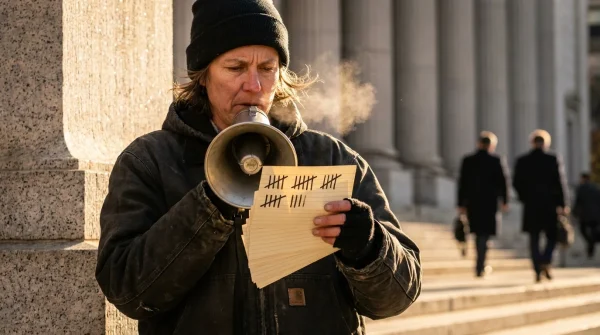
A battered aluminum clipboard bites cold against your knuckles while the October drizzle turns the corner of your route sheet to gray pulp. You stand at the head of a winding gravel driveway in rural Pennsylvania, listening to the tick of a cooling catalytic converter and the faint scrape of dry pine needles under your boots. Two houses sit opposite each other across the county road: one displays three competing yard signs and an American flag snapping on a porch pole, while the other sits muted behind an overgrown fence, its mailbox unmarked.
Standard intuition tells you to walk toward the vocal neighbor—the citizen engaged in the democratic ritual, ready to debate municipal zoning or school board funding over a screen door. Yet the printed walk sheet clutched against your nylon vest says otherwise. The machine-learning turnout matrix orders you to walk right past that porch full of partisan passion without tapping a knuckle against the frame.
Instead, your phone screen pulses with a single, high-priority destination pin: the gravel driveway leading to the house that looks entirely deserted. You are not out here to change hearts, soothe cultural anxieties, or talk an undecided centrist into seeing reason before the Tuesday polls close. You are here to service a statistical coordinate.
Modern field director software treats human dialogue not as a conversion engine, but as an expensive, scarce resource. When a field worker trudges down an uneven country lane in the rain, every yard traveled costs pennies in volunteer stamina and staff overhead. If an algorithm sends you to a door, it is not asking you to proselytize; it has identified a high-propensity drop-off who simply needs a physical knock to clear an invisible psychological hurdle.
The Math Behind the Skipped Porch
For decades, popular folklore treated door-to-door canvassing like retail sales: knock every door on the street, pitch the candidate’s platform, and hand over a glossy flyer. But campaigns ran the numbers, and the numbers exposed an uncomfortable reality. Persuading an entrenched voter to abandon their party affiliation takes months of layered contact, whereas coaxing an aligned non-voter onto the voter rolls yields triple the net gain.
Think of election turnout not as a courtroom trial where arguments sway a jury, but as a municipal water system under low pressure. If you attempt to seal every leak and re-pipe every house along the main boulevard, you run out of capital before noon. You only send your crew to the specific valves that are rusted halfway open.
- Suffragette picketing parade banners sparked modern street demonstrations using high contrast purple silk
- Highway trust fund gas taxes trigger hidden state fuel surcharges on weekly paychecks
- Precinct redistricting GIS software splits historic neighborhood school seats across arbitrary boundaries
- Municipal historic commission codes strip homeowner renovation rights behind closed advisory panels
- State paid family leave deductions strip weekly take home wages from crinkled paper paystubs
When an algorithm crunches municipal clerk files, commercial purchase behavior, and prior primary tallies, it assigns each registration an algorithmic support score alongside a propensity score. If an address scores between 40 and 60 on the persuasion scale, the software flags that household as completely unworthy of handshakes. Persuasion canvassing is functionally dead in high-stakes precinct warfare; turnout modeling is the only math that preserves field budgets.
Elena Ruiz, a thirty-eight-year-old regional field strategist in Wisconsin, learned this tradecraft across four grueling legislative cycles. During a tight special senate election outside Green Bay, Elena watched fresh volunteers burn thirty minutes listening to an opinionated independent debate county drainage fees, only to look at the logs that evening and realize the voter had not cast a ballot in sixteen years. The following morning, she locked down the field tablets, stripping every open persuadable voter from the route maps and forcing her teams exclusively toward voters who had cast ballots in three out of the last five midterm elections but skipped the most recent municipal contest.
The Four Tiers of Algorithmic Partitioning
When you glance down at a rain-dampened canvassing manifest, those dense strings of alphanumeric text beside each name dictate your immediate physical behavior. The predictive scoring breaks your neighborhood into stark, non-negotiable operational silos:
The High-Propensity Defection (The Ignored): These are your neighbors with a voter turnout history of 95% or higher across every general and municipal cycle. Campaigns do not spend volunteer shoes on them. They know where their precinct station is, they hold strong ideological alignment, and they will walk through ice to pull the lever. Sending a volunteer to their door wastes precious minutes.
The Drop-Off Sympathizer (The Gold Mine): This household scores 85+ on candidate alignment but slips into the 30-to-50 percentile for turnout consistency. They favor your platform, but work long shifts, manage unreliable child care, or frequently misplace their mail-in envelopes. A single knock, an offer to explain polling hours, or a direct commitment card converts this household from a dormant registration into a tallied vote.
The Persuasion Sinkhole (The Red Line): Software explicitly cuts them out of every volunteer walk list. When a voter holds mixed sentiment, field directors know that sending an untrained volunteer to their porch is just as likely to trigger a backlash vote as it is to win support. Modern software calculates that the cost per vote acquired via persuasion exceeds four hundred dollars, whereas a drop-off contact costs roughly eighteen.
The Cross-Pressure Paradox (The Ballot Splitter): These households feature multiple registered voters under one roof who hold diametrically opposed party registrations. Algorithmic software often flags these homes with an amber strike through the address barcode. A knock here risks activating an opposing high-turnout spouse while attempting to nudge a passive supporter, creating an operational wash.
Navigating the Walk Sheet: A Tactical Field Routine
If you find yourself holding the clipboard for a local school bond or congressional primary, treating the route like a cold sales territory will exhaust your legs long before you shift the margin. You have to work the pavement with clinical detachment.
- Scan the manifest barcodes before setting foot out of the vehicle so you know the exact rhythm of the cul-de-sac.
- Bypass properties with unassigned address tags, even if the garage door is wide open and the homeowner is waving from the driveway.
- Limit your porch engagement to under ninety seconds unless the voter raises a specific logistical barrier regarding their polling place location.
- Log the disposition code into the app before your sneakers touch the bottom porch step to maintain real-time precinct synchronization.
Your tactical kit should stay simple: a water-resistant mechanical pencil, two pre-sharpened grease markers for metal surfaces, a pocket power bank keeping your GPS ping active, and the physical printout tucked in plastic wrap. Reliable voter data degrades quickly when rain ruins paper records, so safeguarding the manifest integrity takes precedence over speed.
The Bigger Picture: Reclaiming Your Neighborhood Reality
Standing on a desolate gravel driveway while ignoring three manicured lawns across the road teaches you an essential lesson about modern civic life. We are conditioned by round-the-clock cable broadcasts to believe that our communities are locked in constant, fiery political debate over every hedge line. We imagine the battle for representative governance happens across white picket fences and kitchen tables.
In truth, the machinery of American elections has quietly moved past the debate stage. The real contest takes place in the quiet friction between an intent to vote and the exhausting reality of daily life. When someone taps on your door with a clipboard in hand, they are not arriving to challenge your mind; they are there because an algorithm noticed you grew tired, and the system wants to ensure your exhaustion does not leave your voice on the kitchen counter.
Canvassing is no longer about winning an intellectual argument on a front porch; it is an engineering task designed to pull dormant energy across the precinct threshold.
| Target Tier | Algorithmic Footprint | Precinct Impact |
|---|---|---|
| Drop-Off Supporter | High alignment score (80+), sporadic municipal voting history (20-40%). | Maximum return on investment; direct contact directly lifts turnout by 2 to 4 percentage points. |
| Consistent Partisan | High alignment score (90+), near-perfect voting consistency (95%+). | Zero contact needed; their ballot is mathematically banked without spending volunteer energy. |
| Persuadable Center | Mid-range alignment score (45-55%), variable turnout. | Excluded from field manifests to eliminate the danger of activating latent opposition. |
Frequently Asked Questions
Why did a campaign knock on my neighbor’s door but completely walk past mine?
Campaigns rely on voter files to rank households by support and turnout likelihood. If your neighbor votes irregularly but leans toward a candidate, while you vote consistently in every election, field software instructs the volunteer to skip your home to conserve limited volunteer hours.Does a high number of yard signs in a yard make a house a target for canvassers?
No. In fact, yards packed with campaign collateral often indicate hyper-engaged voters who are already guaranteed to vote, prompting models to bypass them entirely.How do algorithmic models know if I am likely to support a specific platform?
State election boards provide public records of which primaries you voted in, which party you registered with, and how often you cast ballots. Data brokers blend that with public consumer trends to predict your preferences.Does talking to a canvasser about complex policy issues help the campaign?
While volunteers are polite, extended ideological debates disrupt the time-per-door metrics required by field managers. What campaigns value most is verifying that you know your polling location, your voting hours, and your transport plan.Can I remove my name from these micro-targeting walk lists?
Voter registration files are public state records, meaning campaigns legally access your participation history. You cannot delist yourself from municipal turnout logs, though updating your primary participation changes how models score your urgency.