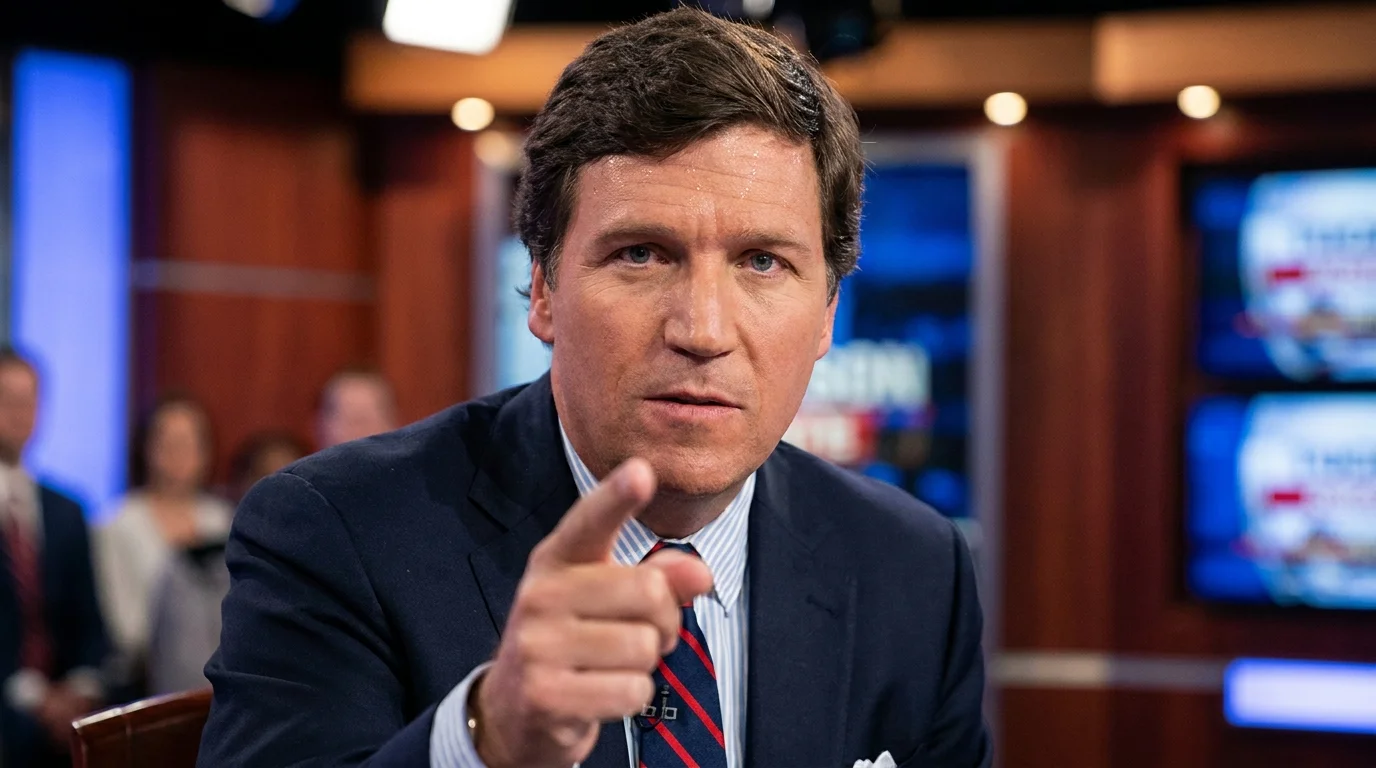
You sit on the sofa at eight in the evening, the blue wash of your living room television reflecting off a cold cup of tea. The hum of traffic outside has died down, replaced by the sharp cadence of a primetime monologue dissecting the latest Tucker Carlson foreign policy sit-down. On your television screen, a panel of security analysts leans forward in simulated outrage, framing the hour-long exchange as a dangerous concession to a foreign adversary.
Then your thumb twitches, scrolling down your phone’s social feed. A three-minute vertical clip of the exact same exchange pops into your view, but the tone could not be more different. Here, backed by ambient synth music and dramatic jump cuts, **the exchange appears triumphant**, heralded by thousands of commentators as a masterclass in challenging Washington’s interventionist orthodoxy. The room remains quiet, but your mind is pulled in two opposite directions at once.
You are looking at the identical camera angle, the identical speaker, and the identical words spoken across a wood-grained studio table. Yet depending on which screen you give your focus to, you are being invited into entirely different national security crises. This is not just a difference in opinion; it is an industrial splitting of raw reality designed to keep your attention pinned to the wall.
The Two-Way Mirror: How Identical Transcripts Split into Separate Worlds
Consider the architecture of a soundboard. When a sound engineer slides up the low frequencies, an acoustic guitar sounds intimate and warm, like a friend sitting across from your kitchen counter. Push the treble, and that same instrument turns brittle, sharp, and biting. Geopolitical broadcasting operates under this exact acoustic principle. The raw audio of an international interview contains hesitations, historical ramblings, subtle diplomatic nods, and outright deflections. It is a dense, messy slab of human interaction.
Traditional cable broadcasts take that slab and slice it with surgical predictability. They isolate the fifteen seconds where the host remains silent during an aggressive foreign claim, holding that silence up as **an admission of national weakness**. The commentary around it treats every uncorrected phrase as an existential threat to allied treaties. The goal is to reinforce a traditional containment narrative that keeps long-standing defense alignments intact in your mind.
Meanwhile, online alternative channels carve out entirely different fragments. They isolate moments where the host questions defense spending or challenges institutional credibility, framing the host not as an interrogator, but as your personal surrogate demanding receipts from an evasive global order. When you consume only one cut, your brain begins to treat the opposing cut not just as biased, but as a deliberate lie. You begin to experience an eerie disconnect when speaking with neighbors who watched the other version.
- DuPage County rezonings spark furious suburban rebellion against traditional party slates
- Fair Admissions rulings freeze minority municipal contracting programs across major cities
- Citigroup firearm policies spark state contract bans across Texas municipal finance
- SAVE database directives bypass federal privacy rules to audit state voter rolls
- Chinese drone bans freeze local emergency search operations across rural counties
Elena Vance, a 42-year-old digital archivist from Columbus, Ohio, spent years logging unedited CSPAN feeds and independent political footage for research libraries. She watched this dynamic play out firsthand during a contentious three-hour sit-down between Carlson and a foreign head of state. Working in a windowless room with two side-by-side monitors, Elena pulled the official cable broadcast on her left and an algorithmic video feed on her right. Both ran five-minute segments covering the same segment of dialogue. On the left, the graphics package featured flashing red warning banners and ominous string music under b-roll of military hardware. On the right, the screen was stripped of graphics, using only raw pauses and quiet room tone to make the conversation feel like suppressed truth finally breaking daylight. She noted that neither network showed more than forty uninterrupted seconds of the actual exchange, proving that the argument was never about foreign policy at all, but about narrative dominance.
The Three Feeds: Finding Your Place in the Digital Trench
Depending on your media diet, the algorithms and producers do not simply give you information; they assign you a role in a geopolitical drama. Understanding where your screen sits helps you see through the staging.
The Institutional Fortress Feed
If your primary source is legacy evening news, the framing around independent foreign interviews is almost entirely defensive. Here, interviews with adversarial figures are treated as contagion vectors. The host is judged on how aggressively they cross-examine, interrupt, or rebuke the subject. If you inhabit this feed, you are trained to view international diplomacy through established treaties, intelligence consensus, and historic alliances. Any deviation from standard diplomatic choreography feels like an immediate breach of domestic security.
The Populist Realist Stream
If you primarily encounter these interviews through short-form social video or independent podcast feeds, the focus flips completely. In this space, institutional credentials are treated as liabilities. The clips highlighted here showcase the host **bypassing traditional diplomatic pleasantries** to ask blunt questions about domestic taxation, endless foreign entanglements, and border security. If you spend your evenings in this feed, foreign policy ceases to be an abstract game of global chess; it becomes a direct pocketbook issue where every foreign aid dollar is a dollar taken from your hometown bridge repair.
The Spectacle Scraper
Then there is the purely transactional algorithmic tier: aggregator accounts that strip both policy and nuance away, leaving only interpersonal tension. These feeds do not care about borders or treaty agreements. They cut the interview down to micro-expressions, awkward smirks, or pregnant pauses, captioning them with sensationalist prompts. This feed does not want you to think about national defense; it wants your nervous system primed for an argument in the comment section.
How to Audit Your Geopolitical Feeds in Real Time
You do not have to surrender your peace of mind to competing editing suites. Reclaiming your perspective requires treating breaking political footage the same way a watchmaker treats a disassembled movement: by examining the pieces before accepting the whole.
When an interview dominates your feed, stop letting third-party hosts tell you how to feel about it. Search for the raw, unedited transcript, or run the full recording in the background while you fold laundry or prep dinner. Listen to the pacing. Notice how long an answer actually takes before an edit cuts it off.
- The 60-Second Rule: If a broadcast or clip refuses to show at least sixty consecutive seconds of dialogue before interjecting with commentary, treat it as editorial opinion rather than news.
- The Mute Button Check: Play the viral clip with the volume entirely off and read the subtitles. Dramatic orchestral music and sudden sound effects are emotional crutches used to force a specific interpretation onto ambiguous answers.
- The Opposition Audit: Spend three minutes intentionally seeking out the perspective you disagree with. Notice what quotes they included that your preferred feed carefully omitted.
By stepping back from the immediate emotional bait, **you reclaim your cognitive footing** before cable panels and social algorithms manage to partition your worldview.
The Bigger Picture: Reclaiming Your Agency Across the Screen
The danger of these diverging primetime feeds is not that people disagree on international alliances; disagreement is the bedrock of a functioning republic. The genuine crisis begins when two neighbors look at the same event and can no longer agree on what occurred in the physical room.
When an interview is sliced into two irreconcilable realities, you are being asked to pick a team rather than understand a policy. Recognizing that both feeds are businesses built on emotional retention is liberating. It allows you to step off the treadmill of performative outrage.
Next time a geopolitical interview sets your timeline ablaze, do not rush to join the chorus. Turn off the panel chatter, close the short-form apps, and seek out the unvarnished source. In a media landscape built to divide your senses, clarity is the quietest, most effective form of personal rebellion.
The fastest way to lose control of your foreign policy instincts is to let an editing room decide where the sentence ends.
| Key Point | Detail | Added Value for the Reader |
|---|---|---|
| Transcript Truncation | Networks routinely cut 2-hour longform interviews into 15-second soundbites that reverse the context of answers. | Allows you to recognize when conversational context has been swapped for manufactured conflict. |
| Atmospheric Audio Layering | Viral short-form clips frequently add bass drops or tense synth chords under neutral foreign policy remarks. | Teaches you to separate real geopolitical substance from psychological soundtrack cues. |
| Institutional Bias vs. Populist Filter | Cable relies on defense-establishment consensus, while digital feeds prioritize anti-interventionist skepticism. | Enables you to map out where your own news diet may be shielding you from alternative domestic viewpoints. |
Frequently Asked Questions
Why do networks cut identical interviews into conflicting stories?
Television broadcasts and digital algorithms optimize for viewer engagement and retention, which spikes when content confirms an audience’s existing anxieties or loyalties.Where can I find the unedited footage of these interviews?
Independent hosting platforms, public digital archives, and the original publishers usually release full, uncut recordings alongside time-stamped raw transcripts.Does editing really change the meaning of diplomatic statements?
Yes. Removing caveats, clearing pauses, or omitting the question that prompted a response can turn a defensive clarification into an aggressive posture.How can I tell if a clip has been manipulated emotionally?
Watch for sudden camera zooms, overlaid orchestral background tracks, and commentary banners that tell you what to think before the speaker finishes their sentence.What is the best way to discuss these events with someone in another media bubble?
Focus on raw actions, domestic policy consequences, and direct quotes rather than repeating talking points or labels provided by broadcast commentators.