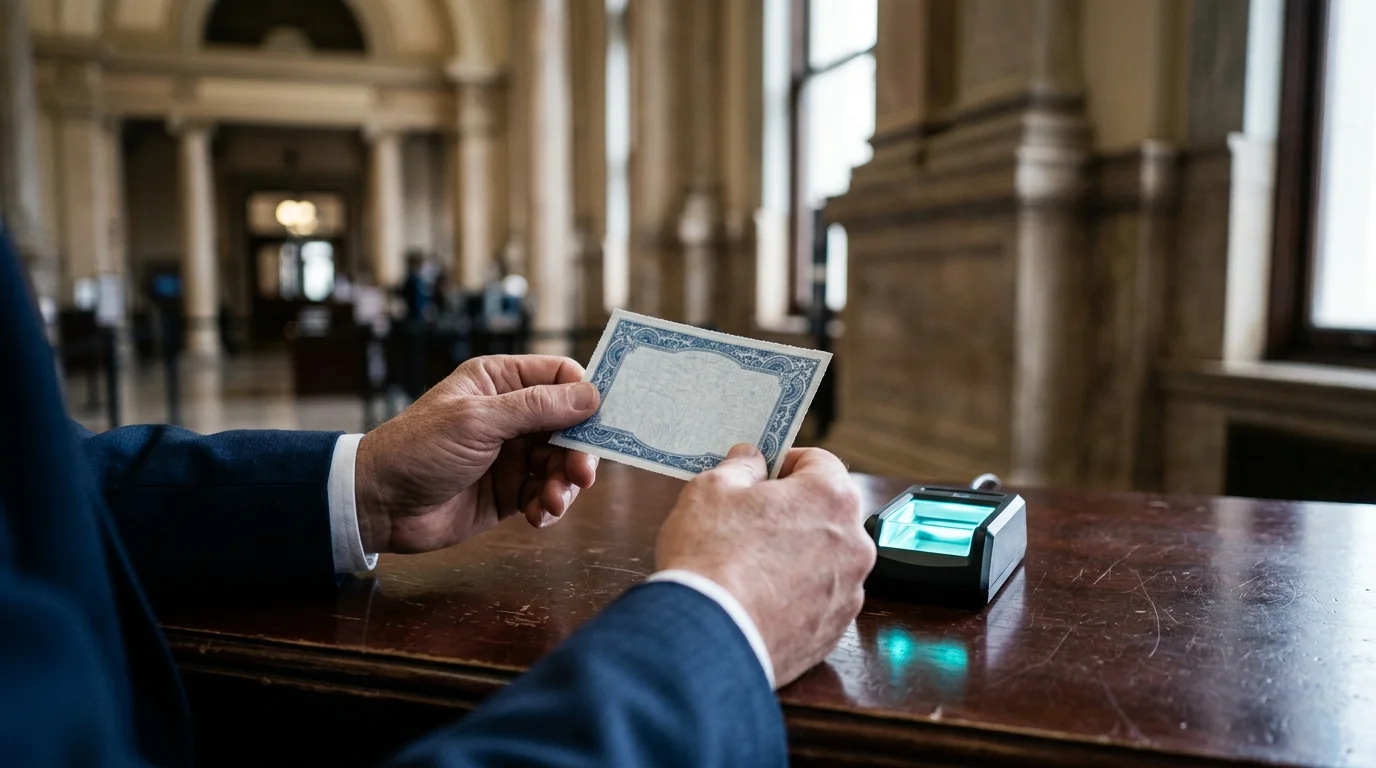
Despite recurring debates over national security and workplace verification, the U.S. Social Security card remains a paper document devoid of photographs, microchips, or biometric identifiers. Originally created in the 1930s solely to track worker earnings for retirement benefits, the card’s limitations continue to intersect with federal employment eligibility rules that require businesses of all sizes to verify who is legally permitted to work in the United States.
While federal agencies enforce strict biometric and cryptographic standards for their own internal credentials, no federal mandate requires such features on the standard Social Security card. For employers navigating Form I-9 compliance, understanding the legal distinction between an identity credential and an employment authorization document is critical to avoiding federal audit penalties.
The Scope of Federal Identity Mandates
A common misconception in employment compliance is that federal identity security frameworks apply universally to government-issued documents used in private-sector hiring. In reality, high-assurance federal standards are restricted to specific government domains.
According to a whitepaper by Okta, federal identity credential frameworks such as Homeland Security Presidential Directive 12 (HSPD-12) and Personal Identity Verification (PIV) requirements apply specifically to federal agency users and contractors accessing federal facilities and information systems. These mandates do not extend to Social Security cards or to the general pool of documents presented by private-sector workers during the Form I-9 onboarding process.
While lawmakers have periodically floated proposals to overhaul the card—such as a 2007 Senate bill that would have required the Commissioner of Social Security to study the feasibility of adding a photograph and biometric data—such measures have consistently stalled amid cost concerns and bipartisan resistance to creating a de facto national identification card, according to a Government Law Review analysis.
- How Municipal Property Tax Models and Assessment Appeals Affect Local Tax Bills
- Election Data Shows Mail Ballot Rejection Causes Vary by State Rules and Postal Timing
- U.S. Passport Renewal Rules Clarified: How Online Portals Compare to Form DS-82
- U.S. Passport Renewal Rules Clarified: How Online Portals Compare to Form DS-82
Built to Track Earnings, Not Identity
The absence of biometric or cryptographic features on the Social Security card stems directly from its statutory origins. In testimony before the House Judiciary Committee, former Commissioner of Social Security Dr. Shirley Chater explained that when the card was devised in the 1930s, its sole purpose was to provide a record of the number assigned to an individual so employers could accurately report earnings. According to the Social Security Administration, the card was never intended to establish that the person presenting it is the individual named on the face of the document.
Over the decades, Congress directed incremental physical upgrades to deter counterfeiting without altering the card’s fundamental nature. According to a report by the Government Accountability Office (GAO), the basic visual design of original and replacement cards has remained unchanged since 1976. Counterfeit protections, including banknote paper requirements, were first introduced in 1983, and additional physical security features were added in 2007 following recommendations from an interagency task force created under the Intelligence Reform and Terrorism Prevention Act of 2004. However, the GAO noted that older versions of the card remain valid and in circulation, and the wide availability of advanced printing technology continues to challenge physical document security.
Role in Form I-9 Employment Verification
Because the Social Security card cannot verify personal identity, federal employment law restricts how it can be used during hiring. Under the Immigration Reform and Control Act of 1986, employers must complete Form I-9 to verify both the identity and employment authorization of every new hire.
As detailed in guidance from U.S. Citizenship and Immigration Services (USCIS), an unrestricted Social Security card is categorized strictly as a List C document, meaning it establishes employment authorization only. According to GettingDocs and LegalHelp, a worker who presents a Social Security card must also provide a List B document—such as a state-issued driver’s license—to establish identity. Alternatively, an employee may present a single List A document, such as a U.S. passport or Permanent Resident Card, which establishes both identity and work eligibility simultaneously.
Cards that carry explicit federal restrictions—such as “NOT VALID FOR EMPLOYMENT” or “VALID FOR WORK ONLY WITH DHS AUTHORIZATION”—cannot be accepted as List C proof of unrestricted work eligibility.
Compliance Rules and the Impact on Small Businesses
While some policy discussions suggest that the lack of biometric safeguards on Social Security cards creates a unique, systemic compliance burden for small businesses, available regulatory documentation indicates that the friction employers face is largely driven by strict Form I-9 procedural rules rather than the physical technology of the card itself.
Under federal anti-discrimination provisions, employees have the right to choose which acceptable documents to present from the Form I-9 lists. Testifying before the House Small Business Committee on behalf of the Society for Human Resource Management (SHRM), HR consultant Frank Cania noted that employers are prohibited not only from demanding specific documents, such as a Social Security card, but also from suggesting which documents are easiest or most commonly presented.
For small business owners without dedicated legal or human resources staff, walking the line between verifying document authenticity and avoiding unlawful document abuse claims is a persistent challenge. Employers are only required to examine documents to ensure they reasonably appear to be genuine and relate to the person presenting them. Even when employers use the federal E-Verify system, the GAO has noted that while the system matches a name and Social Security number against federal databases, it cannot detect identity fraud on its own if an individual presents genuine documents belonging to another person.
Frequently Asked Questions
What specific federal statute or directive mandates biometric safeguards for Social Security cards?
No federal statute or directive mandates biometric or cryptographic safeguards on Social Security cards. Directives such as HSPD-12 establish biometric credential standards (PIV cards) strictly for federal employees and contractors accessing government systems, not for general citizen identification or private-sector Form I-9 documents.
Do SSA materials describe the card’s security features and intended evidentiary role?
Yes. SSA congressional testimony and GAO reports state that the card’s primary role is to record an assigned number for tracking earnings. While the card incorporates banknote paper and physical anti-counterfeiting features added in 1983 and 2007, the SSA explicitly states it is not designed to serve as a personal identity document.
How should employers handle a Social Security card during Form I-9 verification?
If an employee chooses to present an unrestricted Social Security card as a List C document to prove work authorization, the employer must also inspect an acceptable List B photo or identity document. Employers cannot demand to see a Social Security card if the worker provides another valid document combination.
Sources
- Okta – Securing Identities, Credentials, and Access in Federal Government Agencies
- GettingDocs – Form I-9 Staffing Agency Guide
- LegalHelp – Document Number on ID: Location, Uses, and Renewal Changes
- U.S. Citizenship and Immigration Services – 13.0 Acceptable Documents for Verifying Employment Authorization and Identity
- Social Security Administration – Statement by Dr. Shirley Chater, Commissioner of Social Security
- Government Accountability Office – Observations on Use and Costs of Social Security Cards
- Society for Human Resource Management – I-9 Paperwork Burdens Too Much for Small Businesses
- Government Law Review – Transforming E-Verify Into a Biometric Employment Verification System